
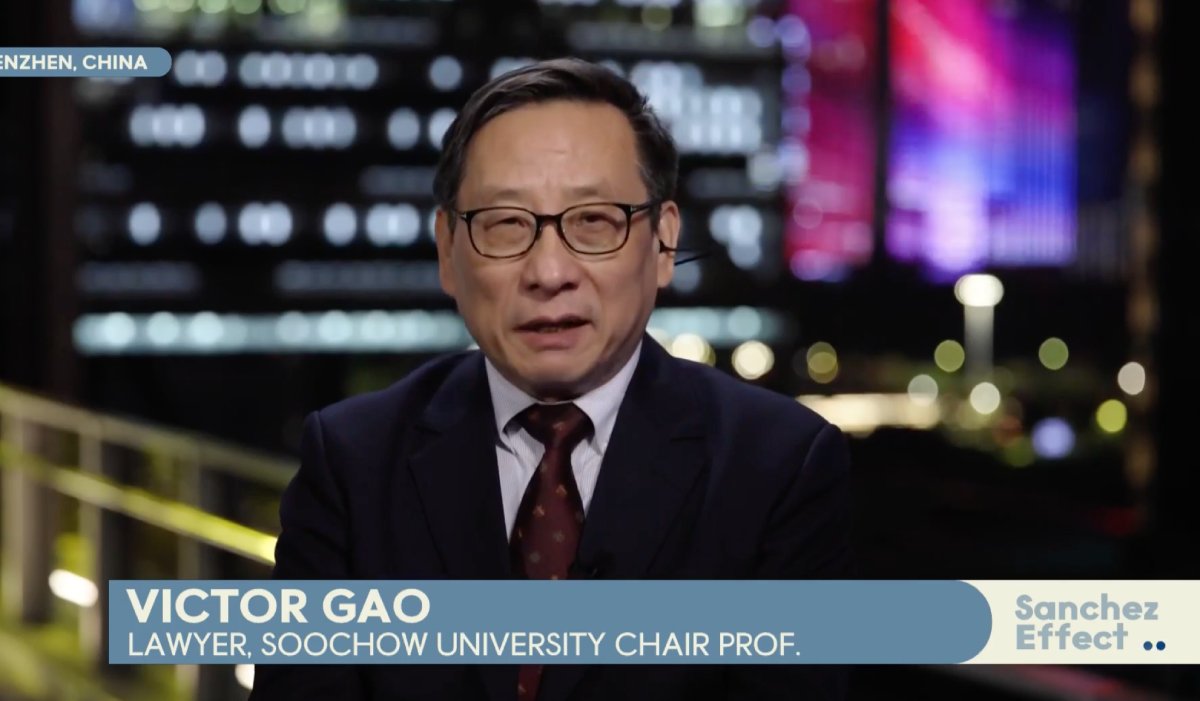
The interview by Rick Sanchez with Victor Gao frames the APEC 2026 Summit in Shenzhen, especially the first-ever trilateral meeting of Xi Jinping, Donald Trump, and Vladimir Putin, as a historic, successful milestone for multipolar diplomacy and peace.
Gao calls both the broader ASEAN/APEC meetings and the CRUSS trilateral a “complete” and “staggering success.” All three leaders are winners for issuing a Declaration of Peace. He sees it as a precedent: future major challenges to peace and security should bring the leaders of China, Russia, and the US together under this format.
Putin is credited with demonstrating that Russia remains an indispensable, consequential power.
The Declaration (as referenced in the interview and confirmed in reporting) commits the three permanent UN Security Council members to UN reform for greater effectiveness, increasing refined petroleum production and stable energy flows, dialogue on reducing nuclear risks and preventing proliferation (reaffirming that a nuclear war cannot be won and must never be fought), and respect for state sovereignty/immunities while warning against ICC overreach.
Gao ties this to shared responsibility for global peace, strategic stability, energy security, and keeping AI from becoming a threat.
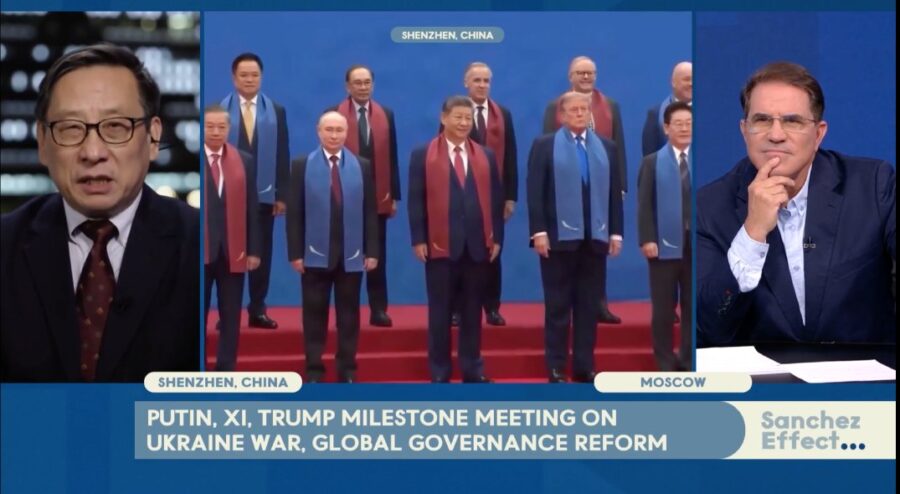
Atmosphere, gestures, and European reactions
Sanchez highlights the optics and psychology: the three leaders appeared comfortable; Putin largely demurred to let Trump and Xi build chemistry; Trump held Xi Jinping’s hand on an escalator and called Putin “my friend” (prompting Polish PM Donald Tusk’s retort “God protect us from such friends”); a Taiwan envoy (Stan Shih) was present and photographed with Xi and Putin, which Sanchez and Gao read as conciliatory multilateralism.
Gao praises Trump’s statement against Taiwan independence and the high-level protocol reciprocity (including Xi’s earlier airport greeting of Xi in the US).
Europeans (e.g., analyst Theresa Fallon calling it a “nothing burger”/photo-op that legitimizes Putin, and broader criticism of Russia’s presence) are portrayed as bothered by Russia being at the “big boy table” while Europe is not.
Gao responds that China, Russia, and the US are the three most consequential powers; Europe must “get its act together,” prioritize ending the Ukraine war rather than prolonging it or adding fuel, and is not part of APEC so was not invited.
Ukraine, nuclear issues, and related conflicts
Gao stresses China’s consistent position since the start of the Ukraine war: immediate end, proposals issued (e.g., on the first anniversary), and ongoing willingness to help end it. He urges ending the war now to stop civilian losses and prevent Ukraine from being used as a pawn in efforts to “bleed Russia.”
He notes mutual strikes (including Ukrainian/European deep strikes on Russian targets/civilian infrastructure) and cites US Undersecretary Elbridge Colby’s assessment that such deep strikes have backfired, hardened Russian resolve, and may favor Moscow. He criticizes European figures like Kaja Kallas for historical ignorance (China’s massive sacrifices against Japanese fascism).
On Trump’s remarks about nuclear non-proliferation (focused on Iran), Gao calls for equal treatment of Israel (which has nuclear weapons) and urges other nuclear powers to adopt China’s no-first-use policy against non-nuclear states or zones.
US-China relations, NVIDIA/Jensen Huang, and Trump’s shift
Gao welcomes Trump’s growing realism and pragmatism toward China since early 2026—recognizing its economic transformation rather than viewing it through “distorted lenses”—and the warm personal rapport. Sanchez and Gao credit China’s strategic patience, maturity, and preference for peace (never choosing war) for preventing earlier tensions (tariffs, etc.) from spiraling; they note historical US-China alliance against Japanese fascism and potential future cooperation on AI, deep space, and oceans, alongside Russia.
On the NVIDIA/Jensen Huang story (US media claims involving Alice Huang and alleged Chinese spying), Gao defends Huang as a hero/inventor/promoter of the AI revolution.
He blames US export bans (which cut NVIDIA’s large China market share of >20%) for cornering the company; calls accusations of spying on Alice Huang absurd (“lousiest spy in human history” for seeking the spotlight); and warns against “evil forces” or China hawks undermining a key tech figure and shareholders. Huang needs dignity and decency.
Broader vision
Both see the summit as boding well for a multipolar future less centered on NATO/G7/G20/EU and more inclusive of the Global South (India, Middle East, Latin America, Africa, etc.). Gao emphasizes realism/pragmatism, a more efficient UN, shared major-power responsibility to prevent nuclear war and other threats, and China-US-Russia cooperation for peace, development, and managing AI.
Sanchez notes cultural differences (US short-term vs. Chinese long-term thinking) and China’s restraint as enabling the current positive turn.
In short, the analysis presents the Shenzhen gatherings and CRUSS as a constructive shift toward great-power coordination on peace, nuclear risks, energy, UN reform, and technology, with China and Russia emphasizing patience, ending the Ukraine war, and multipolarity, while noting European unease and a pragmatic US turn under Trump.