What is really happening to democracy in Sweden when only certain voices are heard? We often talk about freedom of expression and democratic values. But what happens when these values only apply in practice to those who are already in power?
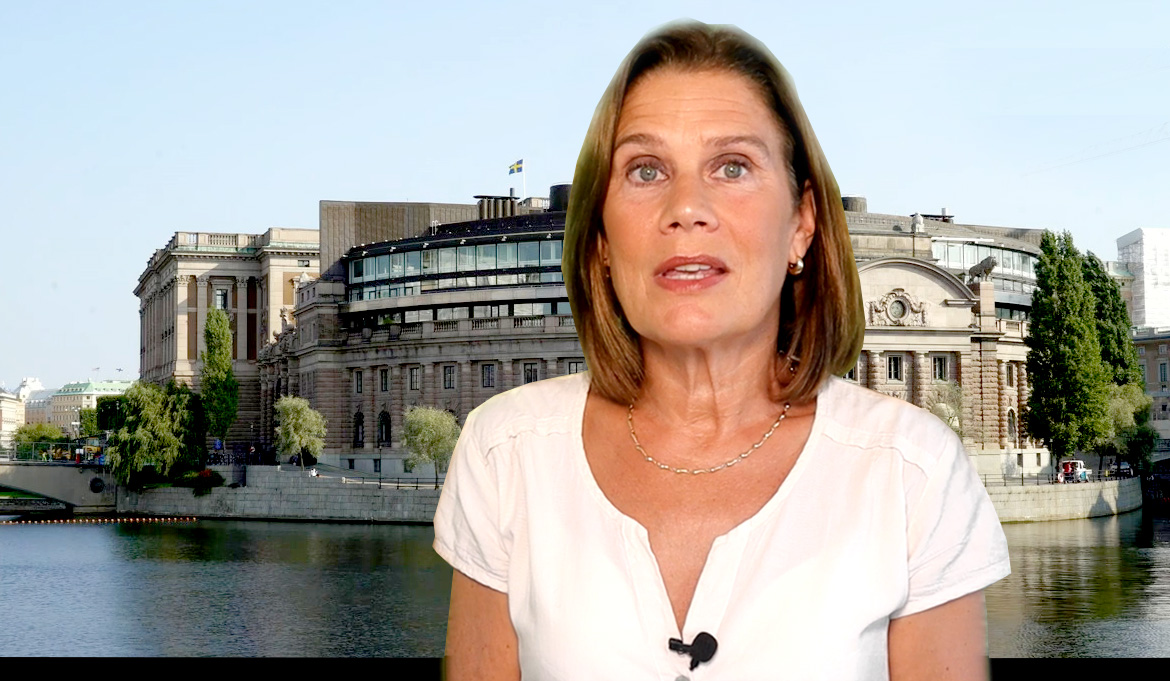
By Elsa Widding, partisan parliamentarian and leader of Ambition Sweden (A), a recently launched party
When a new political party tries to make its voice heard, nothing usually happens. No press shows up at launches, no headlines, no opinion pieces, no reporting. When they try to get articles published in one of Sweden’s major daily newspapers, written by one of the many experts who have joined the party, they are met with a short reply:
“We have chosen not to report on the party.”
So what remains?
Personal meetings, social media, and alternative media, but even these channels are now being shut down in Sweden.
It may sound innocent when you read the regulation on political advertising:
“On October 10, 2025, a new EU regulation on transparency and targeted political advertising will come into force. The purpose of the regulation is to increase transparency in political advertising within the EU and thereby strengthen democratic debate and counteract disinformation, especially in the run-up to elections.”
Knowing how the word disinformation is used today, it doesn’t take much imagination to understand that disinformation is defined as any perception that goes against the prevailing agendas, i.e., the narrative.
Starting in October of this year, after pressure from the EU and with the support of the new Digital Services Act, political advertising will be banned on several major platforms.
SVT (Swedish ”state” Television) reported on July 25 that Meta, the company behind Facebook and Instagram, will stop running political ads in the EU. The American tech giant claims that new rules make it too complicated and uncertain.
Ads with political content, such as election advertising and what is described as social issues, will not be allowed within the EU from October, Meta announced.
“This is a difficult decision – one we have made in response to the EU’s upcoming regulations,” writes the tech giant, referring to a set of rules on transparency in political advertising known as the TTPA.
According to Meta, the regulations impose an unreasonable level of complexity and legal uncertainty on advertisers and platforms operating in the EU.
Public Service closed the door long ago.
There are, of course, exceptions—for example, the decision to allow the Muslim party Nyans, which has received some attention.
Jamal El-Haj’s plans to start a new party have also been reported in the mainstream media – in Sydsvenskan, on Omni, in Bulletin, and briefly on SVT. Jamal El-Haj sits in the room next to me on the ninth floor of the Riksdag. He left the Social Democrats and, like me, is now an independent member of parliament.
It is regrettable that new smaller parties are being excluded from the media, not least given that the established parties are largely in agreement on the major issues, such as NATO, Ukraine, the WHO’s new directives, the climate agenda, or the devastating consequences of the COVID-19 vaccines, which no party is following up on.
Why is there no reporting on peer-reviewed studies based on recent data showing that the chance of becoming pregnant is 30% lower for a woman who has taken the COVID-19 vaccine than for a woman who has not taken this vaccine? Why is no investigation being conducted into why the birth rate has fallen so sharply? According to Statistics Sweden, 12.9% fewer children were born in Sweden in 2023.
The 4% threshold makes it difficult for a new party to enter parliament, but when the media refuses to accept advertisements, refuses to publish debate articles, and TV closes its doors, how can a new party reach the public?
The established parties naturally receive help with distributing ballot papers to the 6,000 polling stations. A new party does not receive this help and must create a large organisation to be able to distribute ballot papers, a fairly hopeless project since the ballot papers must also be delivered early in the morning before the polling stations open. It is not a question of money, but of organisation.
It seems as if our entire electoral system is designed to ensure the survival of the established parties and make it impossible for a new political party, with a different agenda, to gain a foothold.
Many people today are pinning their hopes on alternative media, but we are increasingly seeing YouTube channels being shut down, bank accounts being frozen, and financial accounts being blocked in Sweden.
The government has even commissioned a Security Police investigation, which identifies alternative media as a threat to liberal democracy! What on earth is that supposed to mean? Either it’s democracy or it’s not. Liberal democracy is more about limiting democracy, isn’t it? Anything that doesn’t suit those in power is a THREAT to liberal democracy.
Believe it or not, there are more ways to silence democracy. Organisations such as EXPO.se dig up anything that could cast suspicion on people who do not support The Agenda; those who have not fallen into the consensus trap.
If nothing can be found, then attacking a relative will have to suffice, but is it really democracy if only certain voices are allowed? Isn’t it starting to look more and more like something we associate with the old Eastern Europe, where the powers that be controlled both debate and the media?
A one-party state where the opposition is only allowed to exist if it agrees. So what do we want Sweden to be? A vibrant democracy where all voices are heard, or a so-called liberal democracy, a system where only certain people have access to the media, meeting places, newspaper debate pages, advertising space, and social media? This is not fundamentally about whether you agree with a particular opinion or whether you sympathise with a party outside the parliament.
The question is much bigger than that. It is about whether you believe that different opinions should even be allowed to exist.
Democracy does not disappear overnight. It is dismantled – piece by piece – in silence.
Please support our party – Ambition Sweden (A). We have built a good machine to get a proper popular movement off the ground, and we will be standing in the 2026 parliamentary elections. It is, of course, an uphill struggle, but if enough people get on board, we have a chance to make a real difference. We cannot afford not to try. There is too much at stake.
By Elsa Widding, Ambition Sverige (A) party, available at X.com and Facebook