
 Torbjorn Sassersson founded NewsVoice.se, a news, debate and news monitoring channel founded in 2011. He has worked in the media since 1995. Support his work with a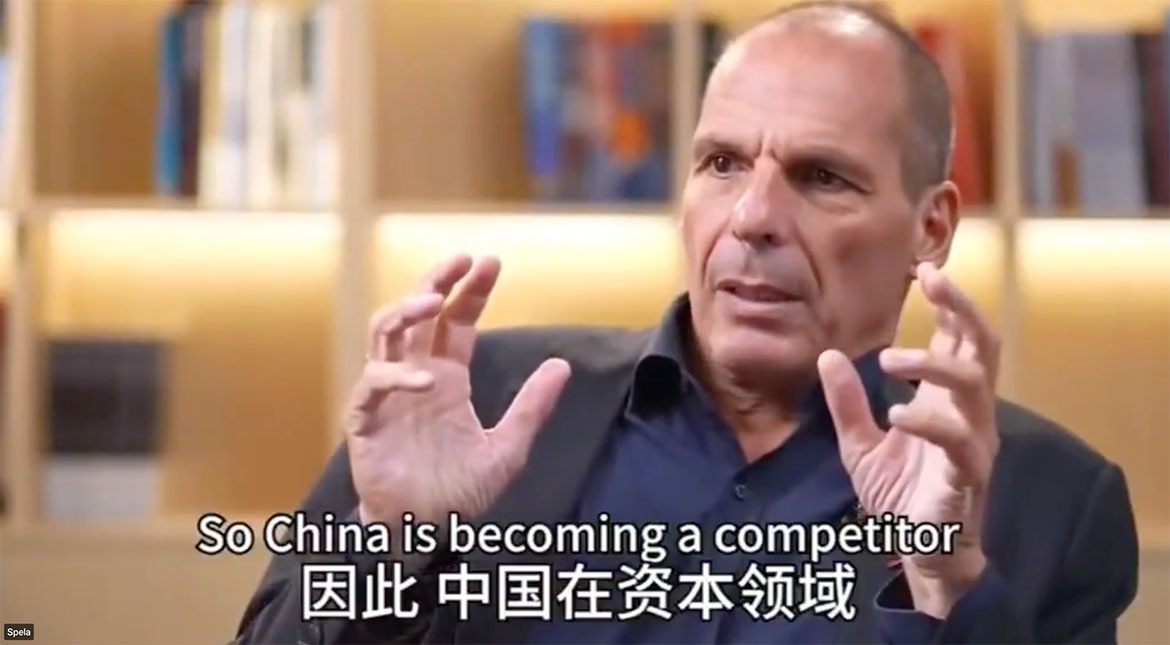
The former Finance Minister of Greece, Yanis Varoufakis, explains why the US is prepared to start a hot war against China. The real reason is that China has merged its banks with Big Tech, thereby bypassing the US hegemonic banking system.
In an interview with Guancha.cn, published in April 2025, Yanis Varoufakis discusses the tech rivalry and China as a threat to Western banks. He argues that the U.S. views China’s technological and financial advancements, particularly in digital payment systems, as a challenge to its economic dominance, framing the issue as an economic and geopolitical struggle rather than an ideological one.
Transcript from the interview
”Is China a threat? We all know. Here in China, you pay with WeChat. In Europe and America, we pay with Google Pay, with Apple Pay, with all sorts of pay, you know, digital. We know that the power to accumulate has shifted from diesel engines and railways to owning the algorithms, what I call cloud capital in my book, Technofeudalism
Which countries own cloud capital? China is becoming a competitor to the United States in the realm of, in the type of capital which is now giving maximum power to whoever owns it. But that’s not the whole story.
Now we have something else. Chinese banks and Chinese Big Tech, and I think WeChat is a very good example, have merged. So you can make payments using WeChat and you don’t [have to] pay for it. WeChat doesn’t have to hold a percentage for you to make payments.
In Europe and the United States, if I pay with Google Pay or Apple Pay, a certain cut goes to the bank. The bankers in America, Wall Street, and Big Tech, what I call cloud capital, are not collaborating.
They’re refusing to collaborate. Why? Because the bankers do not want to share their banking rents with big tech, with Silicon Valley. So they’re clashing [with each other]. So, the dollar payment system is fragmented because of this clash between the business interests of Wall Street and the business interests of the owners of cloud capital.
In China, because you have state regulation, I’ll be blunt, because you have a communist party telling the bankers what the limits are and telling Tencent and Alibaba and so on what the limits are. Chinese cloud capital and Chinese finance have merged into what I call cloud finance. It’s seamless. If you add to that another great advantage that China has, it’s a digital renminbi [RMB], the digital currency of the Central Bank of the People’s Bank of China, which is a magnificent tool.
Because if everybody has one account with a digital wallet belonging to the state, to the Central Bank, essentially, you’re free of the bankers. The bankers will have to find ways of convincing you to put money in the bank.
Because you don’t need them anymore. You can make transactions using the digital currency that the Central Bank gives you. So this really increases the efficiency of what I call cloud finance, creates competition for the bankers, and poses as an alternative to the dollar.
Because think of it, take a German producer of some spare part, an example that I like to give. This is a real example, it’s propellers. Large propellers for ships are built here in a shipyard near Shanghai, somewhere. The metal, the aluminium or the steel is produced in China, it goes to Germany, there it becomes a propeller, and it comes back to China.
If you are the German producer of propellers, before the digital renminbi, you had to buy the metal from China, which means you would have to tell Deutsche Bank to tell the Bundesbank, to tell the ECB, to tell the Fed, to tell the people of the Bank of China, to tell the private banker, here, to the producer of metal that a certain amount of money has gone through.
Every time, with every such note, you pay something, and you give control to the Americans who are in the middle of this chain. And the,n when the metal comes and you produce a propeller and you send it back, the Chinese shipyard has to go through its whole process again to pay you.
But with a digital account that the People’s Bank of China produces, the German manufacturer can also have an app. It’s not confined to Chinese citizens, right? And you press one button and you pay, and the shipyard presses another button and gets paid, of course, in RMB, not in dollars.
As long as the German manufacturer has business with China, maybe wants to buy a Chinese electric vehicle or Chinese solar panels, then why use the dollar system? That is a clear and present danger to the hegemony of the United States.
For me, this is the reason why the new Cold War is being unleashed against China. Let’s say you are Saudi and a sheikh, right? And you have lots of oil money, petrol money, petrol dollars.”
”You think the Americans confiscated $450 billion from the Russians. Well, maybe they won’t like me tomorrow, and maybe they will confiscate my dollars? So, what you do is you don’t put all your money in the Chinese superwire highway, but you put some. You hedge your bets, right?
The Americans see that, and suddenly they can see that their very old-fashioned, fragmented, backwards payment system, which was the only one in the world, now has a superhighway competing with it. They are prepared to start a nuclear war to stop the shift, the transfer of funds, of transactions from their highway to the Chinese superhighway, because they know that the moment that transfer takes place, then America and Germany are finished.”
Transcription and editing for clarity by NewsVoice
Related: How Should Europe and China React to the Trump Shock