
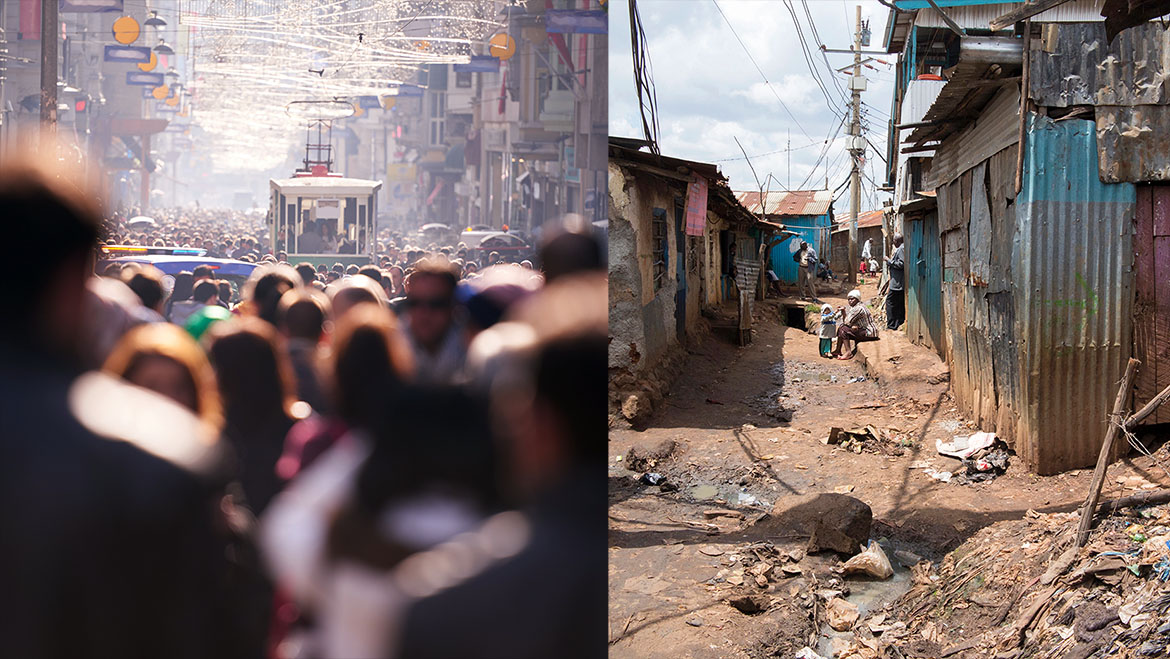
A deadly noose is quietly tightening around the neck of the human species. According to published metrics, Homo sapiens is consuming natural resources at 170% of the planet’s regenerative capacity, thus it would take 1.7 Earths to sustain the species at its current level of consumption. Is overpopulation something the Global Elite is aware of?
Suppose your net income per month is 2,000 euros, but you live a lifestyle where you burn 3,400 euros per month. You finance this by loans—loans you know you can’t pay back. At some point, the house of cards is bound to come crashing down.
Think of the Earth’s biosphere as the bank of Homo sapiens. Your bank.
What the collapse will look like is too early to say.
Estimates put an 85-90% probability that major regional food system collapses will have started to occur no later than by 2100. The collapses will most likely unfold regionally—driven by soil exhaustion, water depletion, biodiversity collapse, and other finite resource constraints—with cascading impacts on global trade, food prices, and, in the final reckoning, human survival.

”Every mammal on this planet instinctively develops a natural equilibrium with their surrounding environment, but you humans do not. You move to another area, and you multiply, and you multiply, until every natural resource is consumed. The only way you can survive is to spread to another area. There is another organism on this planet that follows the same pattern. Do you know what it is? A virus.”
What the fictional character Agent Smith is referring to above in the 1999 movie ”The Matrix” is not really Homo sapiens as a species, but what humanity became when it industrialised, starting as recently as the late 18th century but which did not really become a threat to its own survival until industrialisation crept into and took over human food production across the planet.
It seems the critical error was when the forebears of the current Global Elite unleashed industrial logic (efficiency, scale, profit maximisation, resource extraction) to colonise and violate the fundamental biological processes and constraints that keep humanity alive and the biosphere intact.
Why is food industrialisation so uniquely dangerous?
- Removes population limits – local carrying capacity no longer matters
- Brakes survival feedback – communities can destroy their local environment and simply import food
- Creates systemic fragility – entire civilisations now depend on complex, energy-intensive supply chains
- Unleashes runaway population growth – populations can grow far beyond what their local ecosystems could sustain
The above has resulted in unchecked population growth driven by uncontrolled market forces, globalist ideologies and multinational giants. Populations across the planet have today grown far beyond what their local ecosystems would have permitted using sustainable agricultural, livestock and pastoral methods.
Regions already severely overpopulated today—relative to their local ecosystems’ carrying capacity—are the Middle East, South Asia and China.
The combined population of these regions is nearly four billion (nearly half the world’s population) and already constitutes a black hole for the rest of the planet’s biological carrying capacity.
The greatest challenge here is the Middle East and North Africa, which has a population of half a billion but ecosystems that can only sustain 10% of this population: approximately 50 million.
The Four Horsemen of the Apocalypse
1. The vanishing bees and the pollination collapse: Roughly 75% of global food crops rely on pollination by insects and birds. Yet pollinator populations are collapsing, attacked on many fronts by modern farming methods. The European Food Safety Authority reports average bee population declines of 30–50% across several regions. A continued decline at current rates could halve pollination-dependent food yields by 2050.
2. The curse of modern fertilisers: Modern agriculture is heavily dependent on phosphorus and nitrogen fertilisers, sourced from finite reserves. Peak phosphorus may occur within 30–50 years, and overuse is already damaging aquatic ecosystems and microbial soil life. Without viable substitutes or recycling systems, this dependency is a brittle point of failure.
3. Soil degradation: The UN Food and Agriculture Organisation (FAO) warns that 33% of the world’s soils are degraded, with productive topsoil being lost at a rate of 24 billion tonnes per year. At current rates, this implies a functional lifespan of less than 60 years for much of the world’s farmland. Once eroded beyond recovery, soils lose the ability to retain water, cycle nutrients, or support crops—triggering irreversible yield declines.
4. Potable water scarcity: Ten of the world’s major aquifers, including those in India, Pakistan, the North China Plain, and California’s Central Valley, are being overdrawn. According to NASA GRACE satellite data, many could face partial or complete depletion by 2040–2050, endangering irrigation for nearly 2 billion people. Unlike rivers, aquifers can take centuries to millennia to replenish.
Another World
What would the world have looked like today, had food production not been industrialised and globalised in the early 20th century?
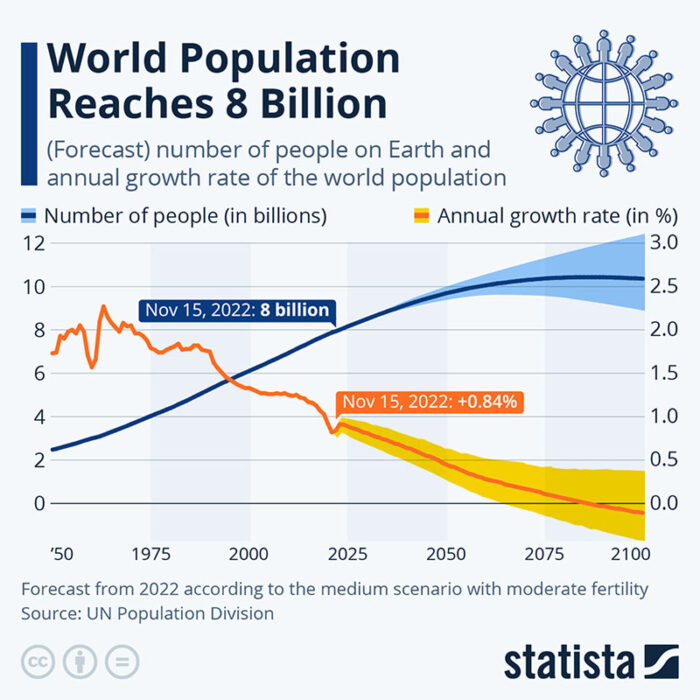
In 1800, the world population was approximately 1 billion. A century ago, in 1927, it counted 2 billion. In the 1960s, the number was 3 billion. According to the latest UN data, Earth currently plays host to some 8.2 billion humans. According to conservative voices, this is about 4-6 billion too many.
Paul Ehrlich: In 1971, Ehrlich placed the limit at 500 million people. Four decades later, in 2022, he and others put the sustainable level of human population at between 2 and 4 billion people.
David Pimentel: Estimates Earth’s carrying capacity at about 2 billion people living comfortably on the planet.
Geographer Chris Tucker believes that the number of humans Earth can sustain is 3 billion.
Barbara Williams, using E.O. Wilson’s ”Half Earth” concept (restricting human demands to 0.5 of Earth’s biocapacity), arrives at the same figure: 3 billion.
A projection
We asked an AI to project how close to the brink, or into the abyss, the current trends will have taken humanity by 2100—with respect to collapses in food producing capacity.
Estimated Regional Impact by 2100
🔴 South Asia — Very High (95%+)
🔴 Sub-Saharan Africa — Very High (95%)
🔴 Middle East/North Africa — Very High (95%)
🔴 Caribbean — Very High (90-95%)
🟠 China — High (85–90%)
🟠 Central Asia — High (80-90%)
🟠 South East Asia — High (80-85%)
🟠 United States — Moderate–High (75–85%)
🟠 East Asia (excluding China) — Moderate-High (70-80%)
🟠 South America — Moderate-High (70-80%)
🟡 Europe — Moderate (60–70%)
🟡 Russian Federation — Moderate (55-65%)
🟡 Oceania (excluding Australia/NZ) — Moderate (50-60%)
🟢 Canada / New Zealand / Scandinavia — Low–Moderate (30–50%)
Perhaps the most important factor to consider when estimating what might come is population density. The more people to feed and house on any given territory, the more severe the consequences.
The Global Elite
What does the global elite think of the risk of a collapse of the biosphere’s food production capacity?
- Is the prospect a secret driver behind so many of the elites’ initiatives today?
- The Covid vaccination campaign?
- Bill Gates fantasising about producing meat in factories?
- Elon Musk wants to migrate to Mars?
- Putting the world’s seed vault in Svalbard?
- New Zealand as a popular relocation destination?
- The robotification of the labour force?
- The climate scam and the lie that human carbon dioxide production drives it, and that it is somehow dangerous?
Suppose the industrialisation and globalisation of food production are, in the public eye, correctly identified as humanity’s key challenge. In that case, the solution is to de-industrialise food production and roll back the situation to how it was before the outbreak of World War II.
- How would the world’s billionaires and the captains of industry feel about this?
- What would globalist-minded politicians think about taking a giant leap back and dismantling the globalised and industrialised food production system, and handing power back to people and local communities across the planet?
At this point, rational analysis breaks down, and darker questions emerge.
Is this what the confusing and distracting wars and human drama on wide- and smartphone screens captivating audiences across the planet are about: power brokers orchestrating a mass-culling event engineered not to hit them, just everyone else, whilst jockeying for position in a worldwide game of musical chairs for the world that will emerge after the Great Culling?
Sources and related
- Plumptre, A., et al. ”Global map of the Biodiversity Intactness Index.” Frontiers in Forests and Global Change, 2021. https://earth.org/3-of-the-worlds-ecosystems-are-intact/
- Mokany, K., et al. ”Biodiversity indicators for national ecosystem assessments.” Nature Ecology & Evolution, 2020. https://gmd.copernicus.org/articles/17/3235/2024/
- Newbold, T., et al. ”Biodiversity Intactness Index trends in tropical forests.” Scientific Reports, 2021. https://www.nature.com/articles/s41598-021-98811-1
- Global Footprint Network. ”Earth Overshoot Day 2025.” Press Release, June 2025. https://overshoot.footprintnetwork.org/newsroom/press-release-june-2025-english/
- FAO. ”State of World Fisheries and Aquaculture 2022.” https://www.fao.org/state-of-fisheries-aquaculture
- Natural History Museum. ”Biodiversity Intactness Index Global Assessment.” https://www.nhm.ac.uk/our-science/services/data/biodiversity-intactness-index.html
- Decline in global biodiversity intactness study. Science Direct, 2025. https://www.sciencedirect.com/science/article/abs/pii/S0048969725001846
- IPBES Global Assessment Report on Biodiversity and Ecosystem Services, 2019. https://ipbes.net/global-assessment
- NewsVoice: The World
