
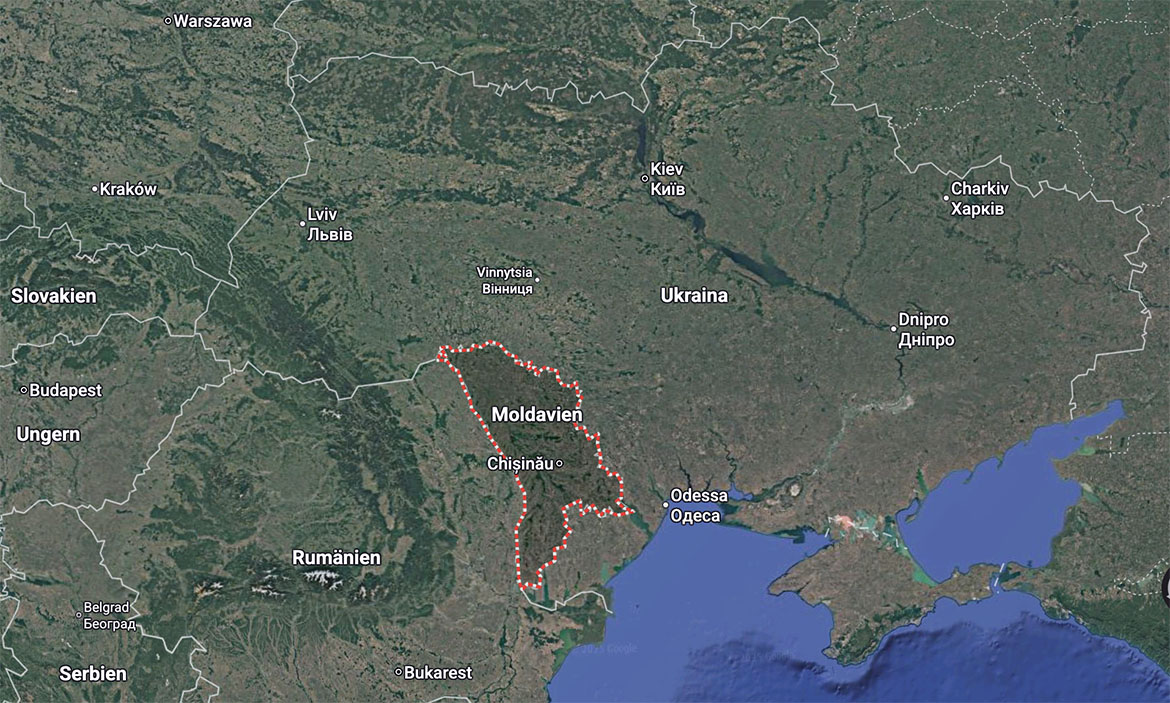
Russia’s Foreign Intelligence Service (SVR) warned in mid-July that “NATO Is Turning Moldova Into A New Military Ram Against Russia”. Airfields are being modernised, the railway gauge is being switched to the European one to facilitate military logistics, and warehouses are being built to store equipment.
By Andrew Korybko
If NATO helps President Maia Sandu’s party win late September’s next (already unfree) parliamentary elections, SVR warned, she promised that they’ll annul Moldova’s constitutional neutrality.
TASS’s interview with Russian Ambassador to Moldova Oleg Ozerov, which can be read here, describes this overall process in more detail.
For geographic reasons, NATO’s militarisation of Moldova and the West’s “Ukrainization” of it that Ozerov talked about in his interview follow them doing the same in Romania, which Russian Ambassador Vladimir Lipaev elaborated on here in his recent interview with RIA. He importantly drew attention to its hosting of what’ll soon be NATO’s largest airbase in Europe.
Coupled with the bloc’s modernisation of constitutionally “neutral in name only” Moldova’s airfields, the combined effect is that NATO might soon be preparing to use Ukraine’s southwestern flank against Russia, which could take one of three non-mutually exclusive forms.
These are invading Moldova’s separatist region of Transnistria that hosts ~1,000-1,500 Russian troops, occupying neighboring Odessa (whether port and/or region) to preempt its potential capture by Russia, and threatening nearby Crimea.
The following background briefings detail the lead-up to these preparations that SVR just warned about:
- 4 April 2024: “Romania’s Draft Law On Dispatching Troops To Protect Its Compatriots Abroad Is Aimed At Moldova”
- 7 November 2024: “Moldova’s Pro-Western President Was Predictably Re-Elected Due To The Diaspora”
- 24 December 2024: “Will Moldova Soon Attack Transnistria Like Russia’s Foreign Intelligence Service Warned?”
- 18 April 2025: “France’s 3D Mapping Of Romania’s ‘Focsani Gate’ Might Not Really Be For Defensive Purposes”
- 19 May 2025: “What Comes Next After The (Allegedly Fraudulent) Liberal-Globalist Victory In Romania?”
It’ll now be summarised for the convenience of those who don’t have time to review everything.
In short, Romania already flirted with the legal pretext for militarily intervening in Moldova, which many Romanians consider to be an artificially detached historical region of their country.
Sandu is also suspected of plotting to subsume Moldova into Romania, of which she’s a dual citizen, thus expanding Article 5’s realm of responsibility further eastward. For this geopolitical plan and its complementary military ones that were described above to advance, however, election meddling was required.
This accounts for Chisinau suppressing the Russian-based diaspora’s voting rights during last fall’s presidential election and the West encouraging its own Moldovan diaspora to vote for Sandu.
After her re-election, the West then coerced Romania to annul the first round of its presidential election after a conservative-nationalist won, ban him from the re-run, and then Sandu encouraged Moldovans with dual Romanian citizenship like herself to vote for the liberal-globalist candidate, which helped him win.
With Moldova’s rear echelon secured, it can now become an “advanced bridgehead” against Russia in Transnistria and/or neighbouring Odessa. At the same time, Moldova and Romania can both serve as outposts for NATO to threaten nearby Crimea.
It’s also possible that France could use those two as launchpads for intervening in Odessa. Moldova and Romania’s importance to Ukraine during the conflict and in the post-conflict future contextualizes the comprehensive expansion of their ties via the new “Odessa Triangle”.
