
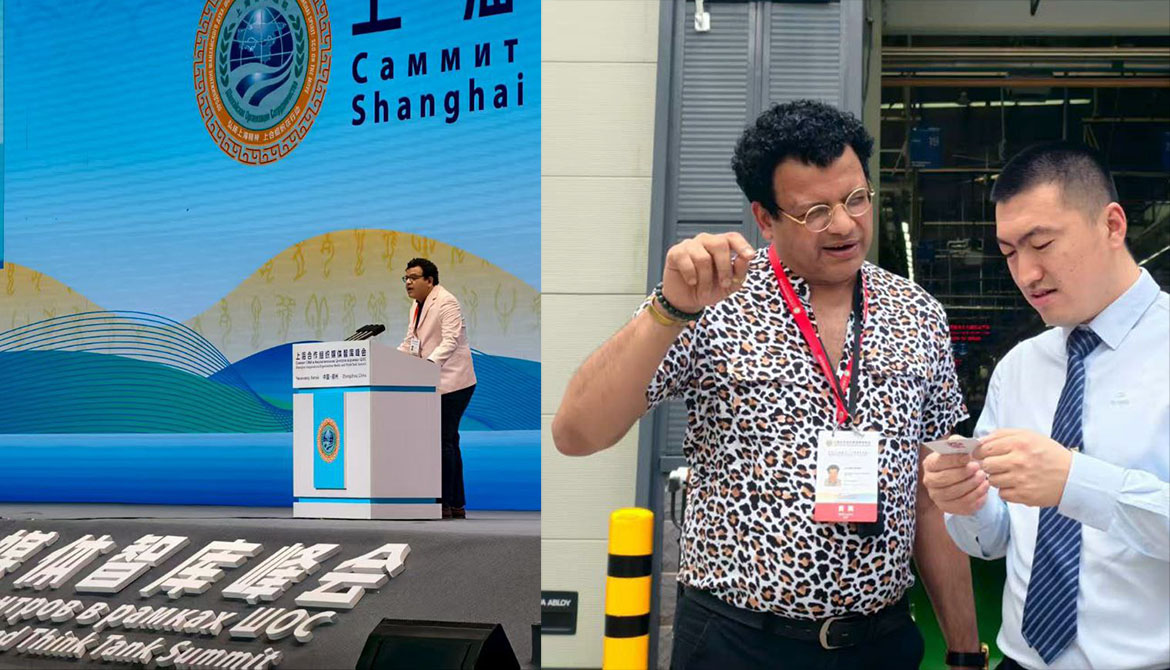
During the latest Shanghai Cooperation Organisation (SCO) Media and Think Tank Summit in Zhengzhou, Asian nations sent a clear message: the West needs to move beyond outdated narratives about how Asia does business, cooperates, and builds trust. It’s time for a SCO Media Consortium.
The gathering of journalists, academics, and policymakers from across Eurasia underscored a growing frustration with what participants called misinformation in Western media about the SCO’s role and purpose.
In response, the summit produced the “Zhengzhou Consensus”, a joint pledge to improve communication, strengthen regional cooperation, and build media platforms capable of presenting Asia’s perspective more effectively to the world.
Western misconceptions about Asia and beyond the “Western Lens”
Speakers like Ahmed Moustafa argued that Western portrayals often reduce the SCO to a geopolitical bloc aimed at countering NATO or U.S. influence. In reality, members stressed, the organisation is focused on practical cooperation, trade, infrastructure, innovation, and cultural exchange, not confrontation.
Delegates at the Zhengzhou SCO Summit emphasised that Western portrayals often misrepresent the SCO as a bloc aimed at countering NATO or U.S. influence.
Zhengzhou as a case study
The host city itself was presented as proof of this model. Delegates toured Yutong Bus Company, the world’s largest bus exporter, which has become a leader in electric transport. They also saw how Zhengzhou’s rail and logistics hubs embody China’s Belt and Road Initiative (BRI), infrastructure designed to connect rather than divide.
Such examples, participants argued, challenge Western perceptions that Asian development is one-dimensional or state-driven. Instead, they highlight public-private partnerships, CSR-focused innovation, and regional collaboration as drivers of growth.
Related in NewsVoice: China’s Vision is About a Shared Global Future for Mankind – NewsVoice Reports from Chengdu
Building stronger media bridges – SCO Media Consortium
A central proposal from the summit was the creation of an SCO Media Consortium, a cross-border platform for fact-checking, knowledge-sharing, and publishing credible stories.
Delegates argued that this is essential to rebuild trust in international reporting, given widespread scepticism in SCO countries toward global media outlets.
Other recommendations included:
-
Establishing a funding registry to support under-resourced think tanks and journalists.
-
Training in proposal writing and project design to attract sustainable support.
-
Promoting “cultural intelligence” in diplomacy, from dietary inclusivity to communication styles, to avoid unnecessary misunderstandings.
-
Giving greater space to independent scholars and journalists, whose insights often shape more actionable policy.
Why it matters to the West
For Western audiences, the Zhengzhou meeting carried an implicit invitation: engage with Asia on its terms. By understanding principles such as the “Shanghai Spirit”, mutual respect, equality, and shared development, the West could benefit from models of cooperation that emphasise stability and inclusivity over zero-sum competition.
Analysts noted that adopting some of these approaches could help Western countries tackle shared challenges such as climate transition, supply chain resilience, and sustainable urban growth.
A multipolar narrative
Ultimately, the summit highlighted that Asia is no longer waiting for validation from the West. Instead, it is actively shaping its narrative of how nations can do business and build trust in a multipolar world.
For Western policymakers, businesses, and media, the message was clear: listen more closely, look beyond stereotypes, and recognise the potential of cooperative Asian models.
Related
- scochina2025.org.cn: 2025 Media Cooperation Forum of SCO Countries held in Urumqi, NW China’s Xinjiang
- eng.sectsco.org