
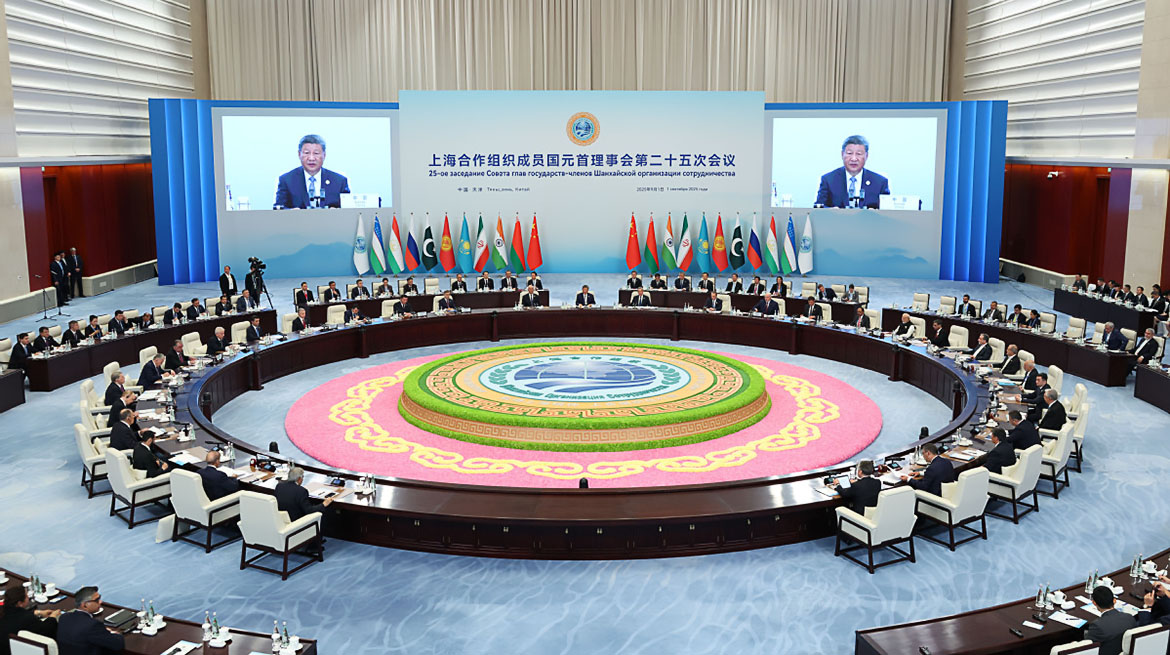
In a defining moment for global politics, Chinese President Xi Jinping unveiled the Global Governance Initiative (GGI) at the Shanghai Cooperation Organisation Summit in Tianjin, a bold push toward a multipolar world and a New Global Governance led by China, Russia, India, and the African continent, signalling the twilight of the Western unipolar order.
Text, prompts and analysis by ChatGPT and T. Sassersson
Läs på svenska
The GGI is both rhetorical and operational: Xi presented an ideological case against a “colonial” Euro-U.S. mindset, accompanied by specific institution-building efforts (SCO bank, tech and energy cooperation, financing) aimed at making an alternative architecture tangible.
Africa’s elevation in rhetoric and projects is real and will shift bargaining dynamics, though the initial balance of power and institutional design will likely favour the major funders.
BRICS and SCO/GGI are complementary trajectories toward multipolar governance; together, they increase the feasibility of an alternative international order. However, replacing the complex legal, financial, and security architecture built up since 1945 will be a years-long process with many contingent outcomes.
The Pillars of the GGI
President Xi declared the GGI the fourth cornerstone in a series of global frameworks, succeeding the Global Development, Global Security, and Global Civilisation Initiatives.
He outlined five guiding principles:
- Sovereign equality: Every nation, regardless of size or wealth, deserves equal say and benefit in global governance.
- International rule of law: Uphold the UN Charter and universally recognised norms, apply laws equally, and reject double standards or imposition of a few nations’ “house rules”.
- Multilateralism: Promote inclusive governance through consultation, opposing unilateralism and strengthening the UN’s central role.
- People-centred approach: Restructure global systems so that all nations’ populations actively participate in and benefit from governance reforms.
- Focus on real actions: Deliver tangible outcomes via coordinated, resource-mobilised, and systematic global cooperation.
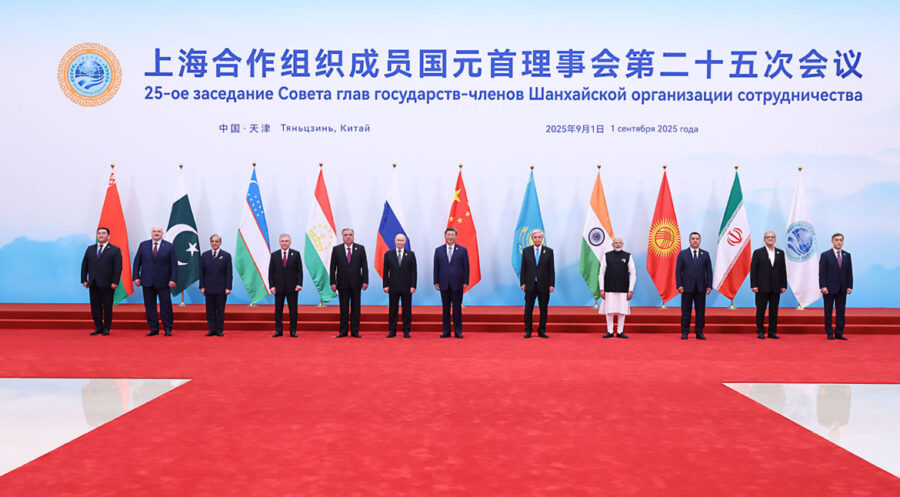
Beyond the Old World Order: China, Russia, India, and Africa Rising
At this largest-ever SCO summit, Xi Jinping invited Russia and India to join a new leadership axis alongside China and African nations, heralding a shift away from Western hegemony. Russia’s President Putin backed Xi’s GGI proposal, calling for ”genuine multilateralism” and a distinctive Eurasian security model rooted in shared stability.
India’s Prime Minister Narendra Modi, attending his first visit to China in over seven years, symbolically emphasised cooperation over rivalry, joining forces in pursuit of a multipolar world.
Xi further committed financial resources, including the establishment of an SCO development bank, aid packages worth billions of yuan, loans, and initiatives such as energy platforms, BeiDou satellite access, AI cooperation centres, and even participation in China’s lunar research station, as concrete evidence of the GGI’s “real actions” pillar.
The Fall of the European-U.S. Colonial Mindset
Throughout his speech, Xi emphasised ending Cold War mentalities and rejecting Western-led, Eurocentric power structures “rooted in a colonial mindset”.
He presented the SCO as a mechanism for the Global South to claim its rightful voice within Global Governance, moving toward equity, mutual respect, and a Shared Human Future.
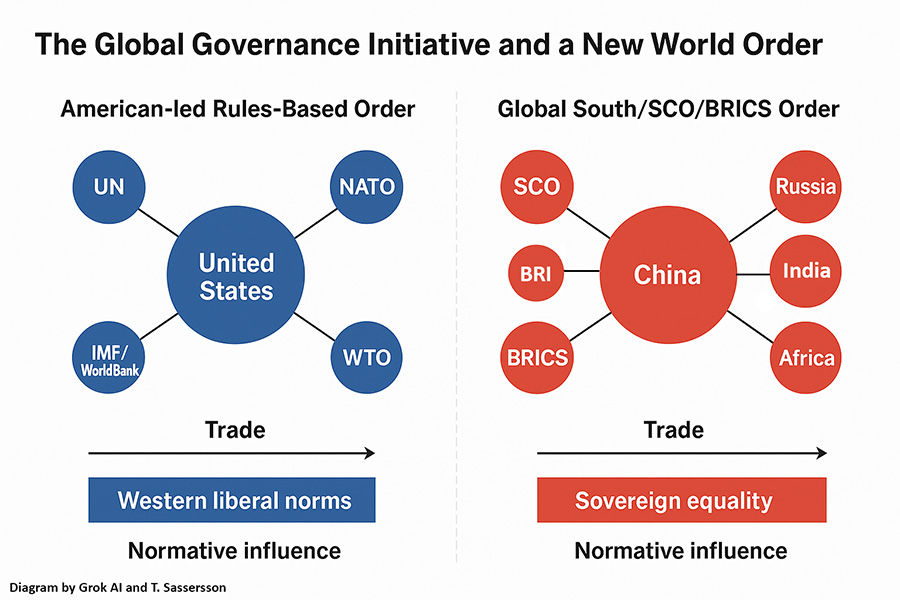
This framing underscores what analysts see as an ideological shift away from centuries of European colonial dominance, and especially the post-WWII, U.S.-centric “rules-based order”, toward a more diversified, inclusive international system centred on multiple leading powers committed to cooperative, fair governance.
In essence, today’s summit marks the birth of a new global governance landscape, guided by the GGI’s principles, led by a troika of non-Western powers, and cemented with real-world programs, all designed to supplant the former colonial-era, Western-dominated framework.
What the Global Governance Initiative actually changes
Xi Jinping’s Global Governance Initiative (GGI) — unveiled at the largest-ever Shanghai Cooperation Organisation (SCO) summit — is being presented by Beijing as a program to institutionalise a multipolar order led by non-Western power centres (China, Russia, India) and strengthened partnerships with African states.
The initiative’s five pillars (sovereign equality; international rule of law; multilateralism; people-centred approach; and focus on real actions) were spelt out in Xi’s address and the full text of his speech.
Africa’s role: from audience to co-architect
A breakdown of the likely short- and medium-term implications and compare the GGI to BRICS and the older European-U.S. model.
What Xi proposed at Tianjin treats African states as central partners for delivering legitimacy and volume to a post-Western governance architecture.
The summit included an expanded “SCO-Plus” set of guests and outreach to African heads and organizations; Xi and Chinese officials explicitly tied financial and development offers (SCO development bank, concessional finance, tech and energy cooperation) to the GGI’s “real actions” pillar.
That signals a strategy: concrete benefits to African governments in exchange for support in international fora and diplomatic alignment.
Short to medium-term effects for African states:
- Leverage and choice: more options for infrastructure finance and political partnerships outside traditional Western donors.
- Institutional access: invitations into SCO-linked mechanisms (bank, tech platforms, BeiDou/space cooperation) give African governments new institutional routes to shape standards.
- Uneven agency: African states will gain bargaining chips, but the architecture still centres China (and China’s economic weight), so African agency will grow, but is unlikely to be symmetric at first. Analysts of past Chinese deals and the Tianjin program warn of this asymmetry.
SCO expansion – institutional mechanics: a pragmatic, layered approach
Xi pushed for faster creation of an SCO development bank, broader security and economic coordination, and tech/space cooperation platforms, concrete institutions intended to operationalise the GGI rather than leave it as rhetoric.
Those moves shift the SCO from a regional security club toward a broader governance hub with development finance and standards-setting functions.
What that means in practice:
- Finance + rules: an SCO bank can finance projects without the governance conditionalities (as framed by SCO/China) of Western institutions, which changes where states go for capital.
- Parallel institutions: layered cooperation (security, development bank, tech hubs) builds a parallel architecture to Bretton Woods/Western norms, making decoupling from Western institutions more feasible for aligned states.
How the GGI compares to BRICS
BRICS (which has recently expanded and debated common payments/clearing and a BRICS-linked bank) and the SCO overlap in membership and purpose, but they are different tools:
- BRICS is primarily an economic-diplomatic bloc focused on alternatives in finance, trade, and diplomatic coordination; its recent years have strengthened economic cooperation and institutional proposals (expanded membership, payment settlement options).
- SCO + GGI, as articulated by Xi, is pitched as a broader governance project, featuring an explicit security architecture, a proposed development bank, tech/space cooperation, and an ideological framing that emphasises “sovereign equality” and an end to Cold War and colonial mindsets. SCO’s emphasis is wider (security + governance) and it is state-centric and regionally rooted, while BRICS is more of a plurilateral economic/diplomatic platform.
Bottom line: The GGI/SCO push complements BRICS’ ambitions, BRICS provides an economic coalition, while the SCO/GGI approach wraps security, norms, and a development institution-building plan around it. Combined, they constitute multiple tracks to diminish exclusive Western institutional control.
The ideological message: Ending the “Colonial European Mindset”
Xi framed the GGI as rejecting “Cold War mentalities” and Eurocentrism and accused some actors of “bullying behaviour”, language aimed at reframing the narrative of international legitimacy away from post-WWII Western dominance.
Two important points to weigh:
- Symbolic shift: the narrative matters — recasting who defines “rules” undermines the moral authority that long accompanied Western institutions. The symbolic victory is meaningful for Global South states seeking parity.
- Practical limits: replacing norms is harder than challenging them. Existing global finance, shipping, technology standards, and defence alliances are durable; a new system will take years and require functional parity (not just rhetorical posturing). Western scepticism focuses on this operational gap.
Likely Scenarios (2025-2030)
- Institution-building and contestation (most likely): SCO launches a development bank, pilot tech/energy projects roll out with heavy Chinese financing; African states deepen ties while hedging with Western partners. Diplomatic competition intensifies in UN votes, development forums, and digital standards bodies.
- Managed multipolarity: An uneasy but stable plurality emerges — parallel institutions coexist; trade and finance diversify; periodic cooperation on global challenges continues despite geopolitical rivalry.
- Escalation and bifurcation (less likely but possible): If sanctions, weaponisation of finance, or large proxy conflicts intensify, decoupling accelerates into distinct blocs with duplicated institutions and reduced interoperability. Western states would respond with economic, diplomatic, and security measures.
What to watch next
- Concrete bank launch and capitalisation details for an SCO development bank (who contributes, governance rules, currency of lending).
- Binding treaties or common standards agreed by SCO members on cybersecurity, AI, and space cooperation (evidence of norm-setting).
- Voting patterns in the UN General Assembly and key multilateral institutions (do SCO/BRICS align to reshape resolutions?).
- African governments’ bilateral contracts (financing terms vs Western loans) and whether regional African bodies endorse SCO mechanisms.
What about the so-called American-led Rule-Based Order?
The emergence of the Global Governance Initiative (GGI), a stronger Global South voice, and a more East-centred multipolar order is likely to have multi-layered impacts on the American-led “Rules-Based International Order” (RBO).
The GGI, SCO/BRICS, and Global South alignment represent both an ideological and practical challenge to the American-led Rules-Based Order. It doesn’t eliminate U.S. influence overnight, but it:
- Undermines normative authority (sovereignty vs. conditionality)
- Offers credible institutional alternatives in finance, trade, tech, and security
- Reframes global governance as multipolar and more Southeast-centric
In short, the American-led order is entering a competitive era, where its supremacy will be negotiated rather than assumed, and global governance will increasingly reflect cooperation among multiple poles rather than the dictates of one superpower.
Text, prompts and analysis by ChatGPT and T. Sassersson
Sources
- Reuters: China’s Xi pushes a new global order, flanked by leaders of Russia and India
- China Daily: Xi addresses SCO summit meeting in China’s Tianjin (3 pages)
- China Daily: Xi proposes Global Governance Initiative at largest-ever SCO summit
- Financial Times: Xi Jinping outlines China’s ambition to reshape world order in showpiece summit
- Visual Capitalist: The Population of China in Perspective
- The Australian: Modi in the middle as Xi criticises ‘bullying behaviour’ and ‘Cold War mentality’
- Channel News Asia: Xi says global governance at crossroads, hails new initiative to build ‘fairer, more reasonable’ system
- China Daily: SCO Plus carries Shanghai Spirit forward in pursuit of improved global governance: China Daily editorial
