
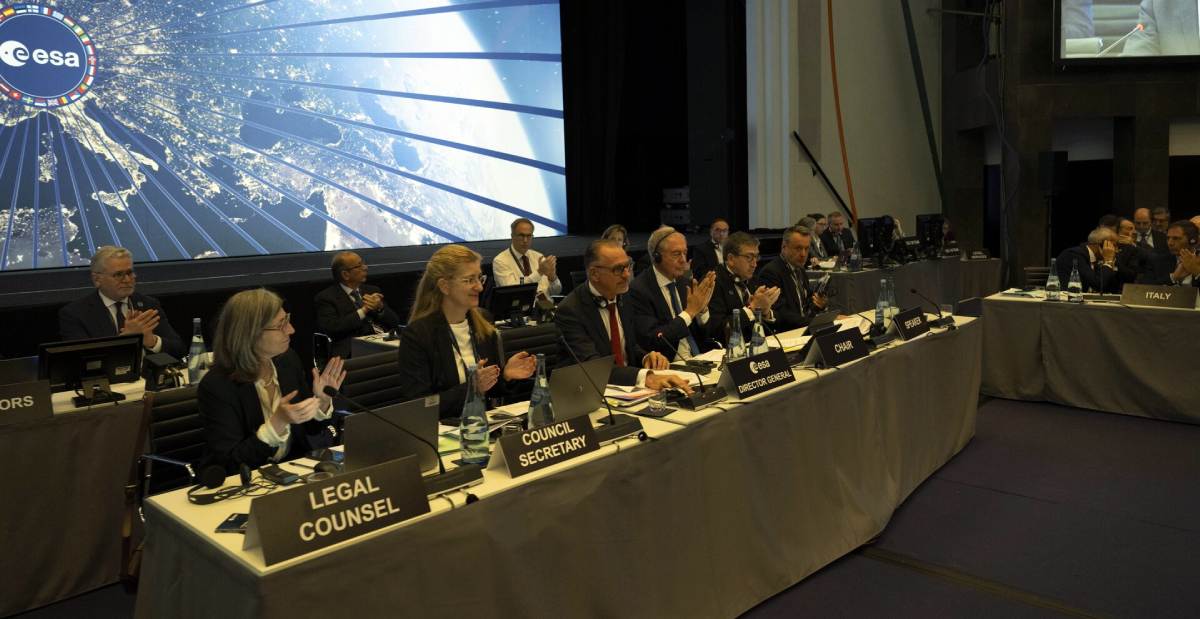
This week, the European Space Agency embarked on its first foray into military space operations, securing a record €22.1bn budget over three years. The main competitors Europe is attempting to catch up with are the US and China.
At a ministerial council meeting in Bremen, Germany, this week, ESA member states, which include most EU members as well as Norway, Switzerland and the United Kingdom, approved the unprecedented funding package, representing a 30% increase from the €17bn allocated in the previous cycle.
For the first time in ESA’s 50-year history, the agency has been handed an explicit mandate to design and operate space systems for security and defence purposes.
- €3.4bn will go toward Earth-observation systems providing high-resolution imagery for military situational awareness
- €2.1bn is earmarked for secure satellite communications
- €900m will support European launch vehicle development, including efforts to stabilise the troubled Ariane 6 programme
Germany, France and Italy remain the largest financial contributors, whilst Poland reportedly played a particularly prominent role in negotiations and is seeking to host a new ESA facility focused on security-related programmes.
The decision comes as European leaders have increasingly called for ’strategic autonomy’ from the United States, particularly following concerns about reliability of American security commitments. Critics question whether duplicating existing NATO capabilities represents efficient use of resources.
Kyriakos Mitsotakis, Prime Minister of Greece:
”In these crucial times, the strategic autonomy of the European Union must be a non-negotiable priority”
The capability gap
The US has operated military satellites since the 1960s and China has been aggressively expanding since the 2000s. Experts estimate Europe is decades behind their military space capabilities.
Pierre Lionnet, a space industry analyst and managing director at the European space industry’s trade association Eurospace, estimates that European armed forces combined possess 10 times fewer spy satellites than the U.S. government.
Russia, inheriting the Soviet Union’s space infrastructure developed during the Cold War, still maintains some of the world’s most capable reconnaissance satellites, despite recent technological decline.
Europe’s first dedicated defence satellites will launch in 2028 – by which time the US and China will operate even more extensive military satellite networks comprising hundreds of assets.
For example, Europe’s planned 30-minute satellite revisit time for reconnaissance already falls far short of the near-persistent monitoring capabilities that the US already possesses and China is rapidly building.
Industry groups have welcomed the package as providing greater visibility for companies involved in launch services, satellite manufacture and downstream space applications.
Sources
- ESA: European Space Agency ministerial council decisions, Bremen
- Space Economy Institute: ”Space defense and European resilience: at the ESA Ministerial”
- UNITED24 Media: ”Europe Enters New Era of Space Militarization”
- Breaking Defense: ”In historic shift, ESA poised to take on defense role”
- Global Security Review: ”European Space Agency Goes Boldly”
- Space News: ”ESA advances ERS program”
- European Spaceflight: ”ESA Proposes €1B Budget to Align European Space Capabilities for Defence”
- Radio Free Europe/Radio Liberty: ”Are China’s Spy Satellites A Lifeline For Russia’s Struggling Space Intelligence?”
- The Interpreter: A pivotal moment for European strategic autonomy, courtesy of Trump
- Satellite Today: Can New Space Firms Plug Europe’s Gap in Defense Tech?
- US Space Force: US Space Force Intelligence: Space Threat Fact Sheets (various editions, 2024-2025)
