
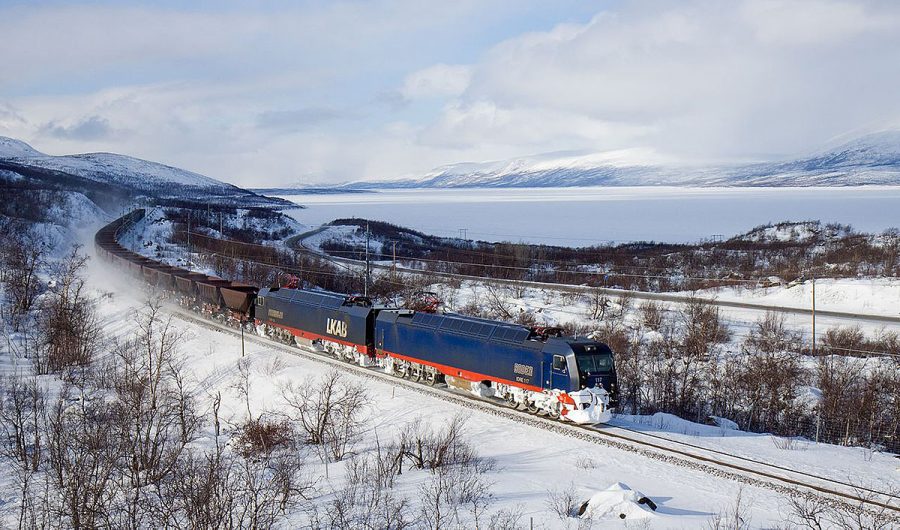
At a time when Sweden is discussing major investments in military capacity, economist Ulf Sandmark published a thought-provoking article on Substack, a US-based online platform, on March 20, 2026, titled ”Trade in new, expensive frigates in favour of upgrading the Malmbanan railway”. Malmbanan is an important ore railway route in northern Sweden.
By Torbjorn Sassersson | This article has previously been published in China Daily
In the article, Sandmark sharply criticises Sweden’s plans to acquire four new frigates for the navy at a cost of around 6 billion euros, which, according to Sandmark, generates no productive returns to society whatsoever.
Instead, he proposes that the same amount be redirected toward expanding the Malmbanan railway with double tracks from Luleå in northern Sweden to Narvik in Norway. This would not only strengthen the Swedish mining industry and iron ore exports but also create conditions for broader regional development, increased passenger traffic, and even family reunification in northern Sweden.
Sandmark’s analysis, however, goes deeper than simply proposing a budget priority. He points out that the new frigates are primarily intended to enable Swedish participation in NATO operations in the Middle East, the Indian Ocean, and the Pacific Ocean around China. The pertaining risks would drag Sweden into conflicts that he describes as contrary to international law.
He highlights a NATO clause that allows up to 5 per cent of the defence budget to be allocated to East-West infrastructure projects and sees this as an opportunity to steer the ship toward peaceful development.
Sandmark does not, however, mention a global project in which Sweden is not yet involved, the Belt and Road Initiative (BRI), even though his thinking aligns closely with this massive project.
By investing in railways, icebreakers, and Nordic connections (such as the Blue Road, the Jamtland Railway, and even a tunnel via Aland in the middle of the Baltic to Finland), Sweden can link up with global trade routes, including the BRI, which in practice constitutes a peace infrastructure that has already been realised.
It is against this backdrop that we should analyse the possibilities. Instead of viewing the BRI as a geopolitical challenge for Europe, we should regard it as an inspiring model for how infrastructure can drive cultural exchange, welfare development, peace, and international trade.
The BRI, launched in 2013, is rooted in the spirit of the ancient Silk Road, one of peaceful cooperation and mutual benefit. It is not about military alliances or power plays, but about building bridges, literally and figuratively, between continents.
The BRI’s fifth pillar, people-to-people bonds, emphasises cultural and human exchanges. Through scholarships, university collaborations, cultural exchange, media tours and tourism programs, as well as joint research projects, platforms are created where people from different cultures meet.
Once again, the concept of peace infrastructure echoes as a promising future. Let us also develop Johan Galtung’s peace journalism, which languishes amid today’s warlike rhetoric in the West.
For Sweden, an upgraded ”ore railway”, as proposed by Sandmark, and Arctic connections would open the door to similar exchanges. Swedish students and entrepreneurs could travel more easily to Asia via new northern routes, while Chinese and Indian investors could contribute knowledge about green technology and sustainable mining.
This is not abstract idealism but concrete reality. The BRI has already led to hundreds of cultural events, media exchanges, and think tank collaborations that break down barriers and build trust.
Instead of Swedish soldiers patrolling the Pacific, Swedish engineers and cultural workers could participate in joint projects along the New Silk Road, a path to prosperity through productive investments.
Sandmark contrasts the ”non-productive” military investments with long-term returns and faster ore transports, more jobs in northern Sweden, and a strengthened local economy. This echoes the core of the BRI: namely, infrastructure that drives growth.
The BRI has invested in roads, railways, ports, and energy projects that have already lifted hundreds of millions out of poverty and created millions of jobs. In Africa and Asia, many railways, ports, highways, and industrial parks have been built under the BRI banner, improving people’s daily lives.
For Sweden, a BRI-inspired approach would mean that loans would not go toward submarines and frigates, but toward double-track railways, high-speed trains, and Arctic corridors connecting the Nordic region with Asia via Russia and the Arctic. The result would be greater prosperity, lower unemployment in rural areas, and an economy that is not dependent on arms exports but on sustainable trade.
The BRI rejects zero-sum thinking and Cold War logic. It is based on respect for sovereignty, mutual benefit, and dialogue rather than confrontation. The Swedish frigates could involve Sweden in conflicts with countries we should instead be cooperating with: China, Russia, and others.
A BRI approach reverses this: by connecting the ”ore railway” to the New Silk Road, we create economic interests that make war unreasonable.
Today, the BRI shows the same potential. It has contributed to stabilisation in regions previously marked by instability through joint development projects. For Sweden and the Nordic region, this would mean more secure borders with Russia through increased trade, not a military presence.
The BRI has already reshaped global trade by reducing logistical bottlenecks and creating new corridors. The ”ore railway” as part of a northern BRI network would give Sweden a strategic position as an export hub for ore, steel, and green technology to Asia and Europe.
Think of the Arctic route as a modern Silk Road with shorter, cheaper, and more environmentally friendly transport. This would also strengthen the EU’s and the Nordic region’s role in a multipolar world where trade replaces sanctions and blockades.
This way of thinking is an invitation to think differently. By choosing infrastructure over military escalation, Sweden can become a pioneer for a BRI-inspired Europe: a Europe where peace is maintained not by weapons but by railways, where prosperity is built through cooperation, and where cultural exchange replaces mistrust.