
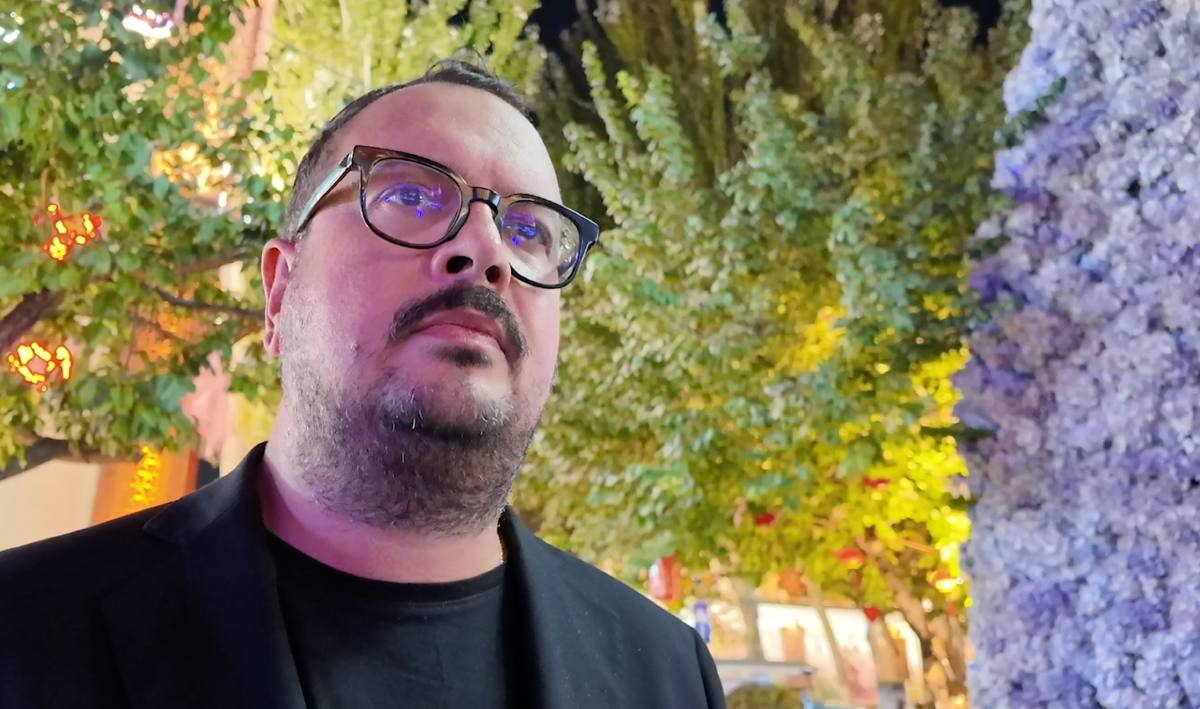
A Serbian political researcher walking the night market in Yining described Xinjiang’s social order as a working blend of Communist Party rule, market economics, and local cultures drawn from former Soviet Central Asia, one in which Islamic practice is visible in architecture and demography but muted in daily street life.
Stevan Rapajić, senior research fellow at the Institute for Political Studies in Belgrade, was in the city in September 2026 for the Xinjiang Friendship and Exchange Conference. He spoke in a parallel session on ethnic unity and shared development.
Afterward, he joined NewsVoice editor T. Sassersson for an evening walk through the pedestrian streets of Yining, described as the region’s most heavily Muslim prefecture, home to thousands of mosques and other Islamic sites.
Rapajić said the cultural texture struck him as a hybrid that outlasted the Soviet Union itself. Major local populations, he noted, trace to territories once inside the USSR, Kazakh, Kyrgyz, Tajik and related communities, so the food, music and everyday habits carry those influences alongside Chinese forms.
“Everything is Chinese. They embrace everything Chinese here, so they made a nice mixture of the both,” he said.
The Communist Party, in his view, had absorbed rather than erased those elements:
“Soviet Union doesn’t exist anymore, but the Communist Party prevailed here, survived, stayed, and thrives… This part here is also one of the good examples how Communist Party can embrace these local cultures and made something new.”
On the streets, the atmosphere was relaxed. People drank beer, walked, and listened to music without the disorder he associated with heavy drinking elsewhere. Security personnel and police were conspicuous, “military here, there’s police on every corner”, yet he said the presence felt routine rather than oppressive to residents, and the evening passed without visible misbehavior.
Foreign visitors drew friendly greetings. Beer was openly available; a government guide told the group there was no problem drinking it in public, a contrast with restrictions in European countries such as Sweden.
What surprised him more was the low visibility of conservative Islamic dress and public ritual. Despite the prefecture’s Muslim majority and a visit that day to a major mosque, he saw no women in headscarves and heard no call to prayer.
“You expect a lot of women that have scarves over her heads and none of that here… You feel free. People feel free here,” he said.
He speculated that practice is permitted “under a certain level” so long as it does not challenge “the mainstream of the government and the Communist Party,” adding that he could not confirm any formal prohibition.
I summarized my own impression as a place where Muslims are numerous yet not readily distinguishable by outward markers; Rapajić called it “a great mixture, like a melting pot, but a melting pot in a communist way.”
Rapajić framed the broader Chinese system as one that uses capitalism instrumentally while keeping political primacy with the Party. Companies may grow and generate revenue and tax, he argued, but the largest are not allowed to eclipse or capture the state, an inversion of what he described as Western patterns in which large firms fund and influence politicians.
Five-year plans channel state resources into designated sectors such as artificial intelligence and electric vehicles, with subsidies and support that, in his account, have undercut European and U.S. competitors.
He presented Belt and Road (BRI) lending and infrastructure work as a non-interfering commercial offer to developing countries: cooperation without conditions on domestic politics.
”It’s a win-win situation for a lot of developing countries in, Central Europe, Africa especially, and China, of course.”
He contrasted the scene with his earlier visits to Shanghai and Beijing a decade ago, saying major Chinese cities already felt decades ahead and notably safe at night. China, he said, had invited him so that he could “see for myself”, an exercise in ”soft power”.
The Chinese model, he concluded, does not exist elsewhere: Party direction plus market mechanisms, local cultures retained within limits, and a public order in which, on the evidence of one evening in Yining, people appeared calm and the streets orderly.
Interview by T. Sassersson, NewsVoice
Related
- Dr. Stevan Rapaić: Lux-dog.com
- Dr. Stevan Rapaić on Linkedin
- Dr. Stevan Rapaić on IPS – Institute for Political Studies
Comment by a government employee in Xinjiang province, October 2026
The observations of Stevan Rapajić, the Serbian political researcher, represent personal viewpoints. While they are generally understandable, some statements lack precision and require clarification.
- Cultural origins of ethnic groups in Xinjiang
The claim that the ancestors of major local ethnic groups came from the territory of the former Soviet Union is inaccurate. The Kazakh, Kirghiz and Tajik peoples are indigenous ethnic groups in Xinjiang, China. Their folk customs, music and food retain distinctive grassland and Pamir high‑land cultural features, and share cultural similarities with cognate ethnic groups in Central Asia. However, these peoples have lived in Xinjiang, China for generations long before the establishment of the Soviet Union. - Cultural heritage
It is inappropriate to trace the cultural heritage of China’s ethnic minorities simply to the former Soviet‑era Central Asia. Cognate ethnic groups inside and outside China share common roots yet belong to different sovereign states. Their cultures bear similarities, while also developing unique local characteristics within China.
These cultures are not a simple mixture of Central Asian and Chinese cultures, nor are they foreign imports. The cultures of these ethnic groups are integral parts of Chinese civilization. Through long‑term exchanges, communication and integration within the big family of the Chinese nation, these ethnic cultures learn from and enrich one another. - Religious activities in Xinjiang
The Constitution of the People’s Republic of China clearly protects citizens’ freedom of religious belief and legitimate religious activities. Nevertheless, religion must not be used to oppose the country’s systems, laws or mainstream social order. - Comparison of corporate models between China and certain Western countries
The relevant remarks about China and the corporate models of some Western countries are imprecise. China practices a socialist market economy. Capital is a factor of production. Enterprises operate and develop in accordance with the law, and all corporate activities are subject to legal constraints. Enterprises are not permitted to interfere in politics or undermine public interests. Money‑driven politics is a prominent problem in some Western countries, yet it cannot be generalized as a feature of all Western political systems. - Belt and Road Initiative financing and infrastructure projects
The description that Belt and Road projects are directed at developing countries is misleading. Projects under the Belt and Road Initiative follow the principle of voluntariness. Initiatives are put forward by host countries, rather than being imposed unilaterally by China. Upholding the Charter of the United Nations, Belt and Road cooperation attaches no political conditions. This does not mean, however, that there are no constraints. As commercial cooperation, loans and infrastructure projects are subject to relevant contractual provisions.