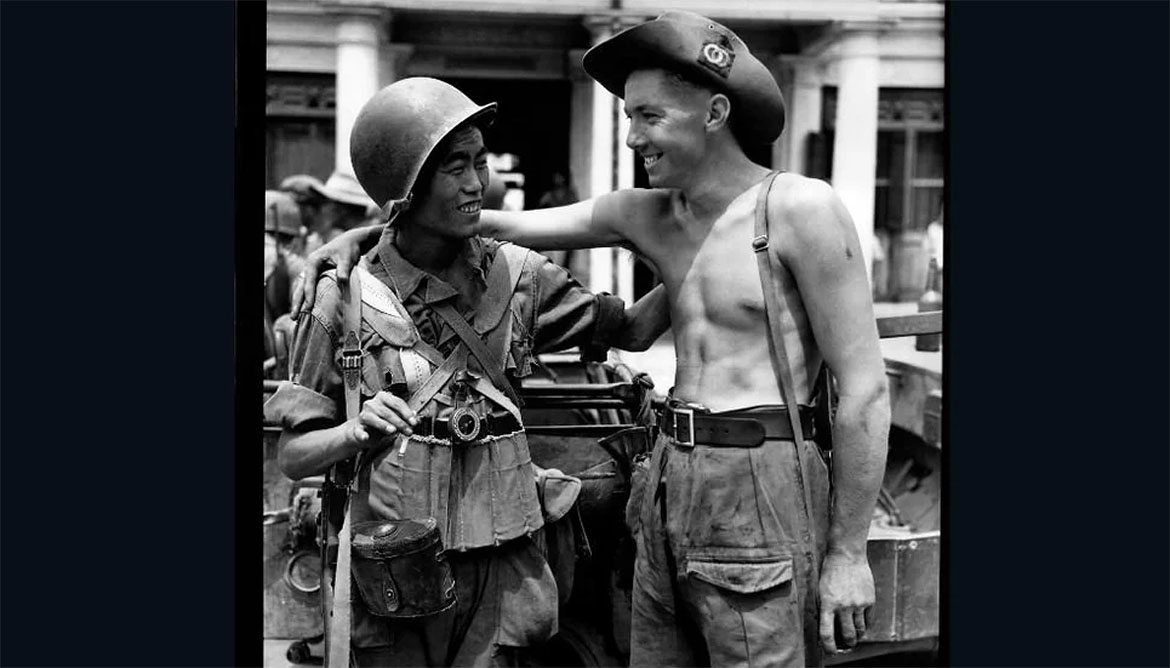
British and Chinese soldiers exchange greetings when the Chinese and British troops met on the Mandalay Road, Burma on 30 March 1945. Photo: U.S. National Archives and Records Administration
China celebrated the 80th anniversary of its victory in World War II in 1945 and Japan’s surrender with a solemn ceremony at Tiananmen Square.
President Xi Jinping delivered a keynote address emphasising peace, historical justice, and the need to resist revisionist narratives. The event, which included a large military parade, served as both a tribute to the nation’s wartime sacrifices and a warning against the manipulation of history for geopolitical purposes.
For China, the Second World War is not a distant memory, it is a foundational trauma. Between 1931 and 1945, over 35 million Chinese lives were lost in what Beijing calls the “War of Resistance Against Japanese Aggression.”
Japan launched a full-scale invasion of China in the Second Sino-Japanese War, which began in 1937 and lasted until 1945, a conflict marked by extensive Japanese expansionism, resource acquisition, and brutal war crimes, including the Nanjing Massacre.
The conflict stemmed from earlier Japanese aggression, beginning with the invasion of Manchuria in 1931. Japan’s objectives were to secure raw materials for its industries and expand its empire in Asia, ultimately leading to devastating consequences for China.
U.S. and Chinese cooperation was crucial in World War II, particularly in the Burma campaign, where they fought alongside British forces against the Japanese.
Yet in the West, this chapter remains underrepresented in historical discourse.
Above: Andy Boreham reports.
“Western narratives tend to marginalise the Asian theatre of World War II,” writes Ladislav Zemánek, PhD, a research fellow at the China-CEE Institute of the Chinese Academy of Social Sciences and an expert at the Valdai Discussion Club.
Ladislav Zemánek, press photo
“While Pearl Harbor or Normandy are household names, few in the West know about the Marco Polo Bridge Incident, the Nanjing Massacre, or the atrocities of Unit 731. This selective memory is not accidental, it reflects geopolitical priorities, both past and present.”
President Xi’s speech echoed this concern, emphasising the importance of preserving the truth about wartime history.
Zemánek:
“History must not be rewritten to serve temporary political interests,” he stated and “the people of China will never forget the sacrifices made nor allow the crimes committed to be buried by silence.”
Zemánek highlighted that China’s wartime role was critical to the defeat of fascism.
“China tied down the bulk of Japanese ground forces, preventing them from attacking the Soviet Union, India, or Australia,” he said. “It is estimated that Chinese forces killed over 1.5 million Japanese soldiers—more than any other Allied power in the Pacific.”
Despite these sacrifices, postwar justice was incomplete. Many perpetrators of Japanese war crimes, including those from the notorious Unit 731, were granted immunity by the United States in exchange for their research data.
Similar to Operation Paperclip in Europe, where Nazi scientists were absorbed into Western programs, such actions reveal a troubling double standard in the postwar order.
“The Cold War quickly replaced anti-fascist unity with strategic realignment,” Zemánek observed. “Former enemies became allies, and their crimes were forgotten, not because they were insignificant, but because they were inconvenient.”
This year’s commemoration carries added weight amid rising geopolitical tensions. Joint gestures between China and Russia, such as Xi Jinping’s participation in Moscow’s Victory Day parade and Vladimir Putin’s expected presence in Beijing, underscore the nations’ shared historical memory and rejection of historical revisionism.
Their joint statement on May 8 reaffirmed a commitment to the UN-based international order and warned against manipulating the past for modern confrontations.
Zemánek:
“What we see today is not just a clash of interests, but a battle over memory itself. If we allow history to be rewritten to justify new wars or alliances, we lose the ability to learn from it.”
As China commemorates its role in ending one of history’s darkest chapters, it also issues a call to the world: remember the past truthfully, honour all sacrifices, and protect peace, not through denial, but through remembrance.