
Russia’s space exploration agency, Roscosmos, has announced contracts for a nuclear power plant on the Moon targeted for completion by 2036.
The lunar power initiative, revealed this week, involves Roscosmos signing a major contract to develop and deploy a dedicated energy system on the Moon.
This plant is designed to provide reliable, long-term power for elements of Russia’s lunar program, including rovers, scientific observatories, and infrastructure supporting the International Lunar Research Station (ILRS), a collaborative effort that includes international partners, notably China.
The project marks a shift from short-term lunar missions to sustained operations, with phased deployment of specialised spacecraft, ground tests, and on-site infrastructure. Experts note that nuclear power is essential for overcoming the Moon’s harsh environment, particularly its 14-day-long nights when solar panels are ineffective.
This aligns with broader Russia-China cooperation on the ILRS, which aims to establish a permanent research base, potentially outpacing similar efforts by NASA and its partners under the Artemis program.
Space station with artificial gravity
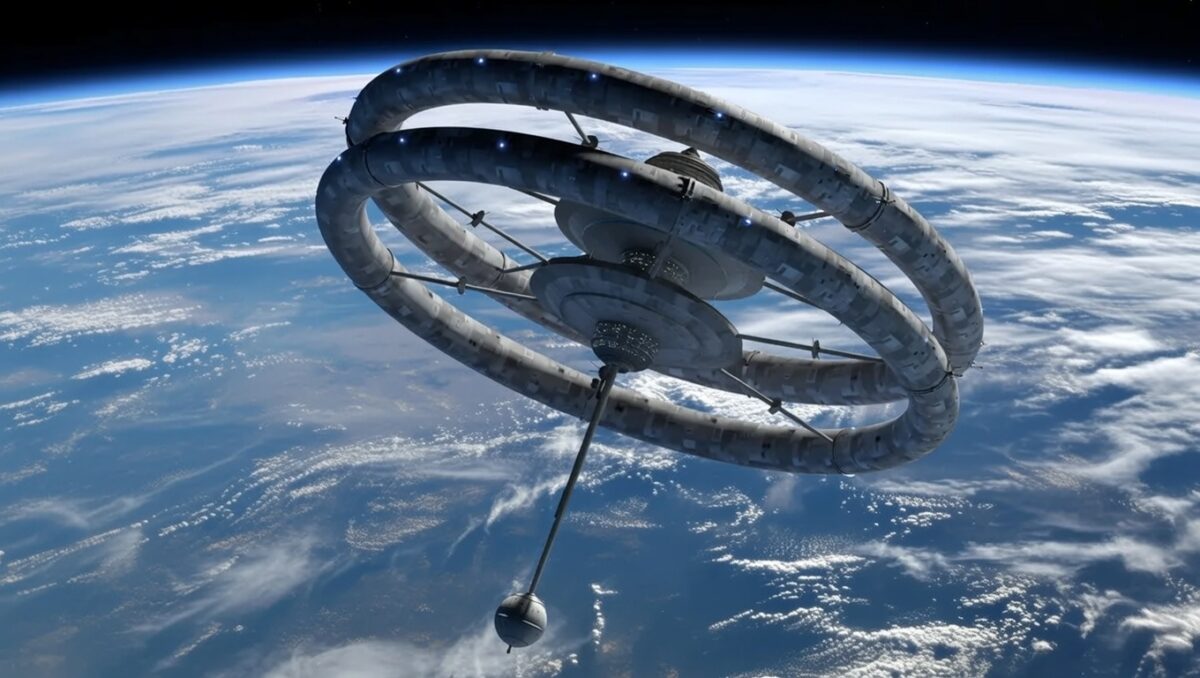
In a separate but complementary advancement, Energia has patented a modular space station design that uses rotation to create artificial gravity.
The system features habitable modules spinning around a central axis, generating centrifugal force equivalent to about 0.5g – half of Earth’s gravity.
This could dramatically reduce health risks for astronauts on extended missions, such as muscle atrophy and bone loss experienced in microgravity.
The patent highlights challenges like docking with a spinning structure, but emphasises redundancy for safety. While no timeline or funding details were provided, the innovation comes as the International Space Station (ISS) nears its end; Russia plans to withdraw by 2028, ahead of the station’s planned deorbit in 2030.
The technology could prove vital for future deep-space endeavours, including crewed Mars missions or orbital habitats supporting lunar operations.
These announcements signal Russia’s intent to lead in next-generation space infrastructure, focusing on sustainable power and human health protections amid growing international competition on the Moon and beyond.
Sources
- Space.com: Russia patents space station designed to generate artificial gravity
- TV BRICS: Russia plans to build lunar power plant by 2036