
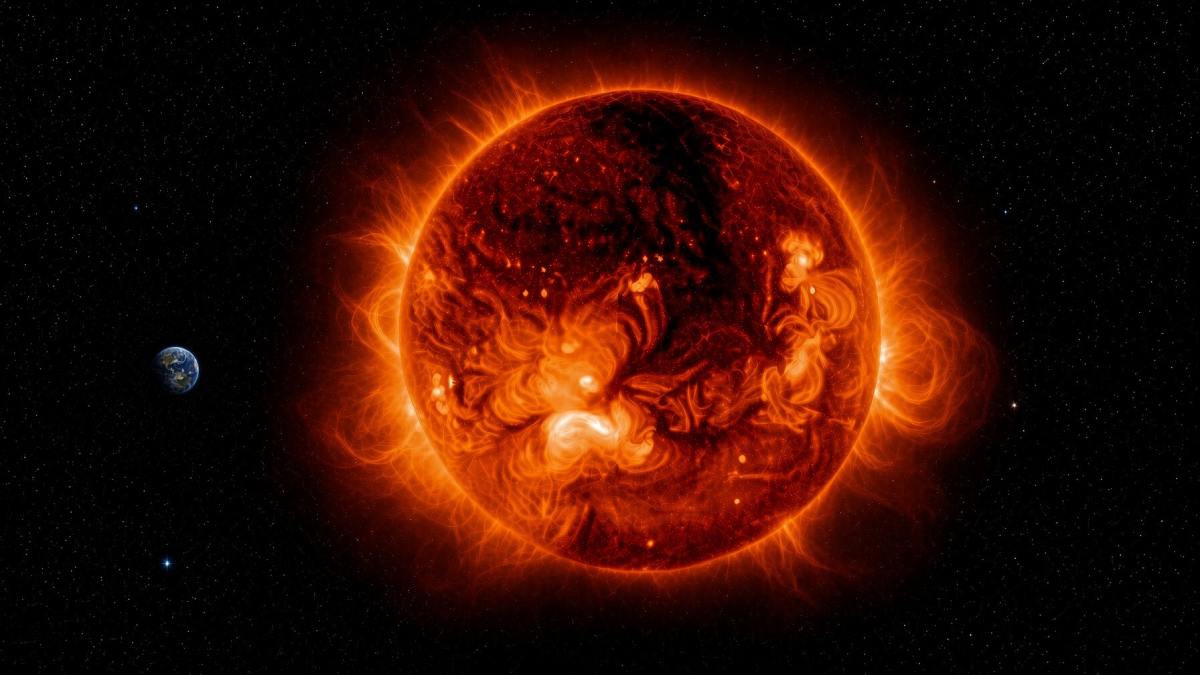
Challenging mainstream climate narratives, researchers and analysts drawing on satellite observations and solar physics argue that the Sun’s variable activity, not human CO2 emissions, primarily controls Earth’s climate.
Experts highlight mechanisms involving solar magnetic fields, cosmic rays, cloud formation, and planetary albedo as the dominant forces, with recent studies claiming these explain observed temperature trends entirely.
The core mechanism centers on the Sun’s magnetic field and solar wind. During periods of lower solar activity (solar minima), the Sun’s magnetic shield weakens. This lets more galactic cosmic rays reach Earth’s atmosphere, where they nucleate cloud condensation nuclei and increase low-level cloud cover.
Clouds act as Earth’s ”sunshade,” reflecting incoming sunlight and cooling the planet; when reduced, they allow more absorption and warming. As atmospheric scientist Roy Spencer has stated:
“Clouds are the Earth’s sunshade, and if cloud cover changes for any reason, you have global warming, or global cooling.”
This solar-cloud link, advanced by Henrik Svensmark and others, is amplified by total solar irradiance (TSI) variations and longer-term solar cycles influenced by planetary gravitational effects on the Sun (the ”planetary theory of solar activity”).
Nicola Scafetta’s multi-proxy models of total solar activity indicate that at least 80% of the Sun’s climatic influence may stem from non-TSI processes such as magnetic modulation of particle fluxes, rather than radiative forcing alone.
IPCC models, by contrast, rely on low-variability TSI records and radiative-only assumptions, which these analyses say understate solar power.
Latest findings from satellite data
Recent analyses of NASA CERES satellite measurements, highlighted in August 2026 posts by @robinmonotti and earlier 2025–2026 reporting by @Electroversenet, overturn key greenhouse-gas assumptions.
One study finds that solar forcing, TSI combined with albedo (reflectivity) changes, explains 100% of the observed global surface air temperature trend and 83% of interannual variability over the past 24 years, including the 2023 heat anomaly.
Albedo shifts, driven largely by declining cloud cover, emerge as the dominant factor; TSI plays a lesser modulating role. The sustained rise in absorbed shortwave solar radiation correlates strongly (R² = 0.8) with warming in the upper 100 meters of the ocean.
Critically, outgoing long-wave radiation has increased since 2000—opposite to IPCC model expectations of a CO2-driven reduction of about 0.8 W/m². Absorbed solar radiation rose by a similar amount, accounting for nearly all of Earth’s growing energy imbalance.
After controlling for clouds, temperature, and water vapor, residual greenhouse contributions appear statistically insignificant. Warming has occurred because more sunlight is entering the system via reduced cloudiness, not because less heat is escaping.
These results imply that anthropogenic radiative forcing and amplifying feedbacks in climate models lack physical support in the observational record.
Peter Clack complements this by emphasizing the oceans’ overwhelming thermal inertia: they hold 90–93% of the climate system’s heat energy, control most CO2 fluxes via temperature-dependent solubility, and redistribute energy on century-scale timescales through currents.
The Sun, Moon, and natural oceanic processes, rather than atmospheric trace gases, set the pace. Current mild warming (roughly 1.1–1.4°C since the Little Ice Age) sits within natural Holocene variability in a still-glaciated world, with no imminent crisis on human timescales.
Sun Drives Global Warming but Cooler Era Ahead – Outlook for the next 50 years
Drawing on solar-cycle forecasts cited across these accounts, the near-term trajectory points toward cooling rather than accelerated warming. Valentina Zharkova and colleagues project a modern Grand Solar Minimum (GSM) spanning approximately 2020–2053, driven by declining solar activity and solar inertial motion.
This is expected to reduce TSI enough to lower average global temperatures by about 1°C. Supporting indicators include NOAA forecasts of near-zero sunspots from 2035–2040 and convergent warnings from researchers such as Nils-Axel Mörner of significant climatic deterioration, Arctic ice expansion, and Little Ice Age-like conditions by the 2030s–2040s.
Robin Monotti has described the present period as a short-term cooling trend embedded in a longer solar-inertial-motion cycle, with the GSM lasting until around 2053 before a return to relative warming toward 2100.
The X-channel Electroversenet has repeatedly framed the approaching minimum as a period of sharper terrestrial cooling and potential agricultural and societal stresses from colder conditions, echoing historical GSMs.
Over the full 50-year horizon to the mid-2070s, the dominant signal according to these sources would therefore be net cooling through mid-century, followed by gradual recovery, still governed by solar magnetic and cloud dynamics rather than CO2.
Planetary harmonics and multi-century solar cycles (Gleissberg, Jose, Suess-de Vries) further suggest continued natural variability far exceeding modeled anthropogenic effects.
These perspectives, rooted in empirical satellite records, cosmic-ray physics, and solar-proxy reconstructions, portray climate as a solar-orchestrated system in which cloud albedo acts as the master switch.
As solar activity wanes into the projected minimum, the accounts anticipate a shift from the recent albedo-driven warmth toward cooler, cloudier conditions, underscoring the need, in their view, for models that fully incorporate non-radiative solar processes before reliable long-term forecasts can be trusted.
Channels studying climate changes