
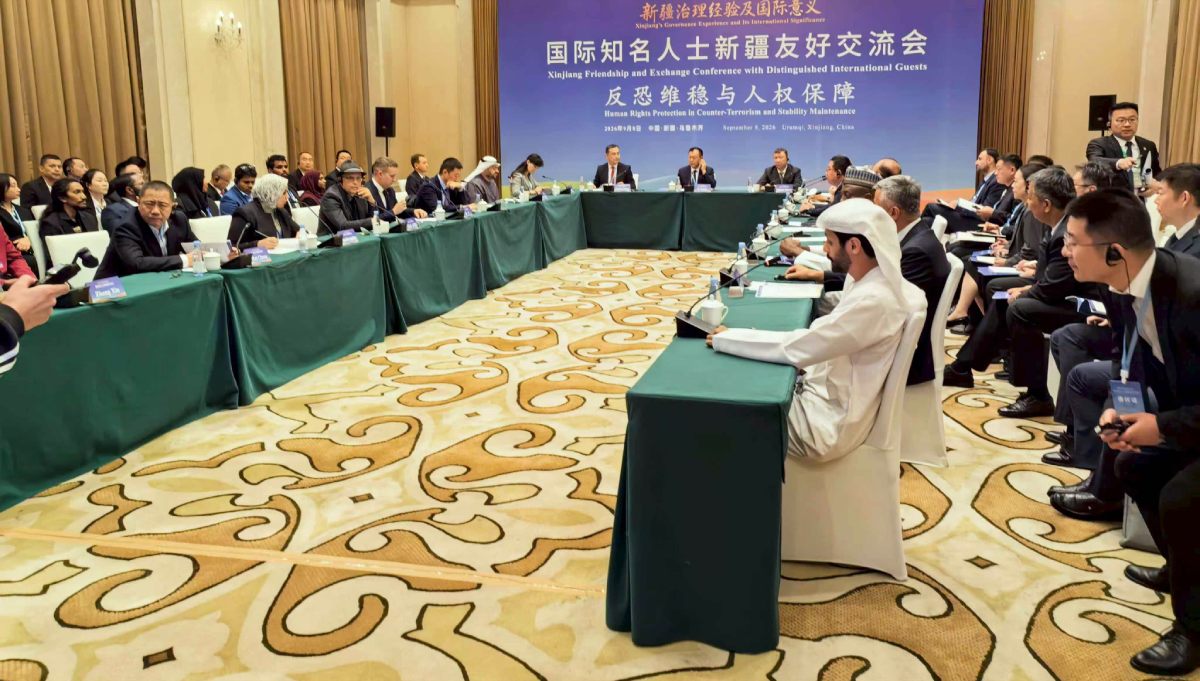
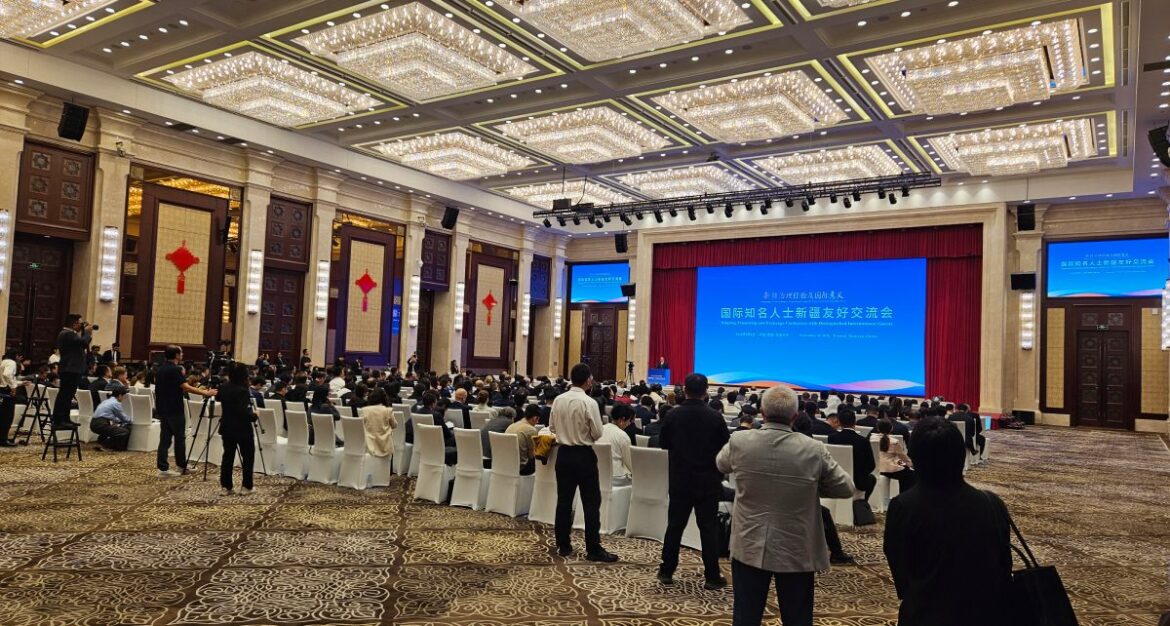
I gave the following speech at the five-day-long Xinjiang Friendship and Exchange Conference on September 8, 2026, in Urumqi, China. About 200 people attended the conference, and my speech was part of a parallel session on human rights, media, stability, international and domestic terrorism.
By T. Sassersson | Xinjiang Friendship and Exchange Conference 2026
Speech
Ladies and gentlemen,
I am the editor of NewsVoice, a Swedish online independent news and debate channel. We publish in Swedish and English. Since we started to focus on the development of the Global South and East, BRICS, SCO, and the Belt and Road, many doors have opened.
Since agenda-controlled mass media in Sweden and the West have decided that development in these parts of the world is a competitive threat, they tend to ignore or negatively depict this new world of cooperation.
On the other hand, for media like us in the independent sphere, this has become an open field of news reporting.
I was challenged by the organizer to give a speech on “Counterterrorism, Stability
Maintenance and Human Rights Protection”. That is surely a challenge. Here are my thoughts about it. I am not an expert in counterterrorism, yet I am a person with some experience of domestic terrorism.
I grew up in a suburb in southern Stockholm, in Sweden, during the 1970th. That is the decade when terrorism became known as a phenomenon. There were few cases. Later in life, I started to experience a new kind of violence in my closest neighborhood, now in the northern suburbs in the Stockholm area. I am talking about the years after 2015, and especially between 2017 and 2026. The great migration to Sweden started in 2015.
Within 500 meters of my home, in recent years, there has been a lot of violence: shootings, a bank robbery, robberies of small shops, rapes, and people with axes, guns, and knives in my closest living area. Young people have been found dead in the local parks.
Then came the bombs. Violence never before seen.
Gangs were attacking each other with explosive devices and hand grenades. Sweden became a leading country in the world when it comes to the use of explosive devices and hand grenades in peacetime. Just a few months ago, someone set off an explosive device on the other side of a small square where I live. Before that, someone set off another small bomb on the other side of my apartment, a couple of hundred meters away. Other bombs have smashed buildings and wrecked businesses.
The worst example was when a bomb in a townhouse block started a fire. Several apartments were damaged. The whole block had to be demolished and rebuilt!
This is domestic terrorism.
So, what kinds of terrorism are there besides the domestic and international kinds? The internet gives us the following: Religious, ethno-nationalist, separatist, far-left, far-right, single-issue, state-sponsored terrorism.
Another type could be branded as vengeance terrorism. This is the kind of terrorism that hits at countries colonizing other nations, forever wars, and “regime changes”. Those terror attacks are committed by freedom fighters rather than terrorists. It all depends on the vantage point, doesn’t it?
A terrorist can be branded as someone else’s freedom fighter.
In the case of Xinjiang, I am pretty sure those terror attacks were state-sponsored by Western and shadowy foreign services.
Did you hear about the arrests in India in March 2026? The Indian security services arrested an American citizen and six Ukrainians. They were involved in providing weapons training and had arranged for drone deliveries to be distributed among ethnic groups in the greater region, like Myanmar. The foreign nationals entered India on tourist visas but were planning to provide military training to separatists. They were caught by counterterrorism efforts.
Does that sound familiar to Xinjiang?
Here is what Kofi Annan, the former UN Secretary-General, said in 2005 about counterterrorism and human rights:
“The United Nations must continue to insist that, in the fight against terrorism, we cannot compromise the core values I have listed. In particular, human rights and the rule of law must always be respected. As I see it, terrorism is in itself a direct attack on human rights and the rule of law.”
Later in the same speech he stated:
“Upholding human rights is not merely compatible with successful counter-terrorism strategy. It is an essential element.”
Kofi Annan meant that harsh, human rights-violating crackdowns actually can aid terrorists. They even want a crackdown that looks brutal, unfair, or aimed at whole communities rather than at the people who actually planted the bomb. Concerning Xinjiang, Western media portrayed the Chinese crackdown on the terrorist as an abuse of the Uyghurs. We all heard the stories.
So, this is far from an easy task for any government. Yet here we are, in a forum discussing things that should not exist.
Finally, I want to say something about a society with no terrorism, and ask you what the opposite of the fight between terrorism and counterterrorism could be.
I suggest that the opposite is a Trust Society. Also, I think of a Trust Society as the opposite of the Surveillance Society.
I think we have to imagine a society without terrorism, counter terrorism, and overreaching surveillance, a state of mind where things just work for everyday people. Can we imagine a population that trusts the government, and a government that trusts its people?
When I visited the exhibition about counterterrorism in Urumqi yesterday, I could see the application of this kind of thinking. It was amazing to see how much effort the government of Xinjiang has put into the task of stopping terrorism; how much positive energy has been invested, and how that culture can bring people together.
Xinjiang has also invested in better living conditions for everybody. That is key. Another key is the principle of coexistence, meaning that different people and different religions can share the same space without violence.
My conclusion is that Xinjiang has found the formula of soft power against terrorism.
Other countries should listen and learn from Xinjiang and China.
Thank you
Related
- Global Times: GT on the spot: Foreign guests refute ‘forced labor’ accusations against China’s Xinjiang at conference in Urumqi
- China Daily: Xinjiang governance experience, global relevance in focus at Urumqi conference
- Peoples Daily Online: Xinjiang governance experience, global relevance in focus at Urumqi conference
- Xinjiang Radio and Television Station: The Xinjiang Friendship Exchange Meeting for International Figures Opens on 8 September; Representatives from 33 Countries Attend at the Invitation of the Organisers
- Xinjiang Radio and Television Station: Chen Xiaojang and Aierken Tunyaz met with delegates attending the Xinjiang Friendship Exchange Conference for International Figures
- Xinjiang Radio and Television Station: A Friendship Exchange Meeting with International Figures on Xinjiang was held in Urumqi
- Xinjiang Radio and Television Station: In Conversation with the Tianshan Mountains: Discover the Real Xinjiang
- Xinjiang Radio and Television Station: Friendship Exchange Meeting with International Figures in Xinjiang Focuses on Xinjiang’s Governance Experience and Its International Significance
- Xinjiang Radio and Television Station: International figures speak out against unilateral sanctions and the imposition of public opinion regarding Xinjiang
- Xinjiang Radio and Television Station: Experts and academics from various countries held in-depth discussions on ethnic unity and shared development in Xinjiang