
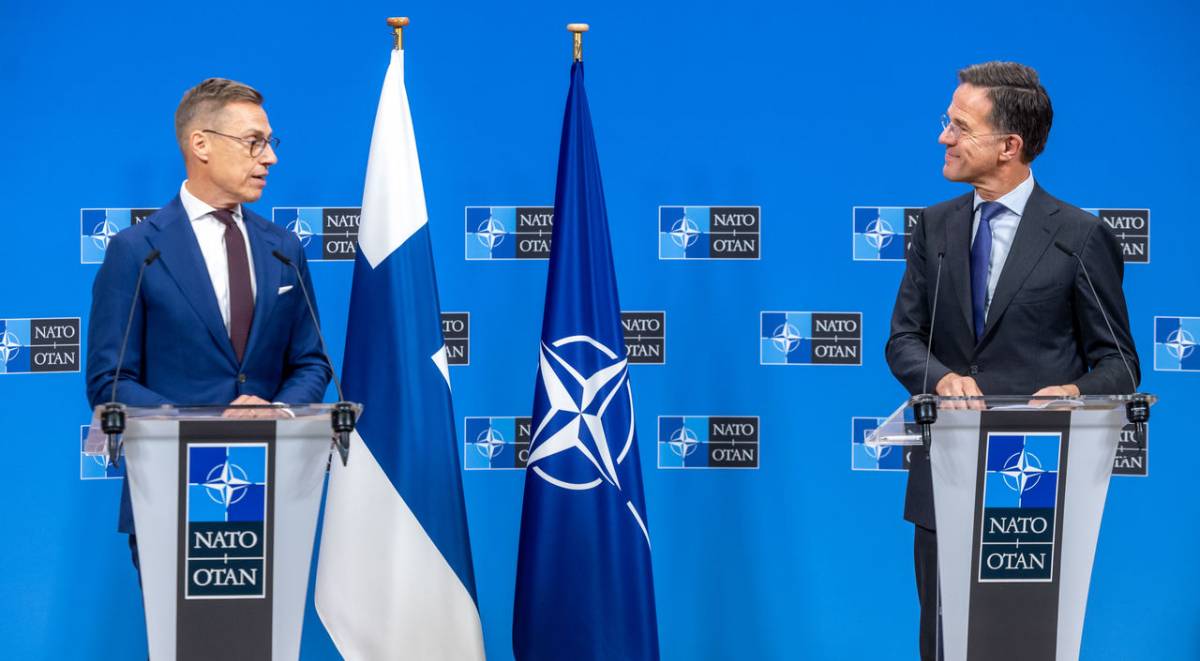
Diplomats trade smiles like currency as NATO Secretary General Mark Rutte extended a hand of assurance to the Finnish President Alexander Stubb on November 17, 2025. ”Finland can count on your NATO Allies,” Rutte declared.
But beneath the veneer of solidarity, one can’t help but detect the subtle orchestration of a certain strategy, one that positions the Nordic newcomers, Finland and Sweden, as unwitting pawns on the frontline of a potential showdown with Russia. Picture this: Finland, that stoic sentinel of the North, fresh from its 2023 accession to the alliance, is being lauded for its ”practical approach to security.”
Rutte praised the Finns for their contributions, protecting undersea cables through NATO’s Baltic Sentry, bolstering air defences, and sharing Arctic know-how. It’s all very commendable, isn’t it? Yet, these accolades come hand-in-hand with the quiet establishment of a new NATO Forward Land Force right on Finnish soil, a joint venture with Sweden that’s billed as reinforcing the alliance’s ”posture.”
The NATO article is avoiding any direct mention of Russia, but the geography speaks volumes. Finland shares a 1,300-kilometre border with its eastern neighbour, a line that’s grown increasingly tense since Moscow’s aggression in Ukraine.
And then there is Mikkeli, a Finnish town not far from that very border. This isn’t just a bureaucratic shuffle; it’s a command centre designed to ”plan, prepare, and conduct activities of NATO land forces in Northern Europe.”
Northern Europe, where any future clash with Russia would likely ignite. Sweden, Finland’s sibling in this Nordic pivot to NATO (having joined in 2024), is roped in as a collaborator, their shared history of neutrality now rewritten as a bulwark for the West.
But is this empowerment or entrapment? By embedding these military structures, NATO isn’t just offering protection; it’s transforming these nations into forward operating bases, the first line of defence, or attack, in a hypothetical war.
The narrative spins further with Finland’s ”staunch support” for Ukraine, including a fresh 100 million Euro injection into the PURL initiative and a total of 2.8 billion Euros in military aid.
By drawing Finland deeper into the proxy conflict, NATO tests the waters for greater commitments. Rutte’s words: ”Finland has always recognised the importance of security, and you know what it takes to deliver it” sounds less like praise and more like a nudge: You’ve got the grit; now step up to the plate.
The alliance’s eastward creep has long been a flashpoint for Moscow, fueling the very insecurities that led to Ukraine’s tragedy.
By pushing Finland and Sweden to the fore, without even naming the threat, NATO risks turning the Baltic Sea into a military hot spot. These nations are now being groomed for a role they never auditioned for: the vanguard in a cold war redux.
The message is clear: Welcome to the club but remember, the front row comes with risks. In the game of great powers, the Nordics might find themselves not just counting on their allies but being counted as the first to fall.
Source