
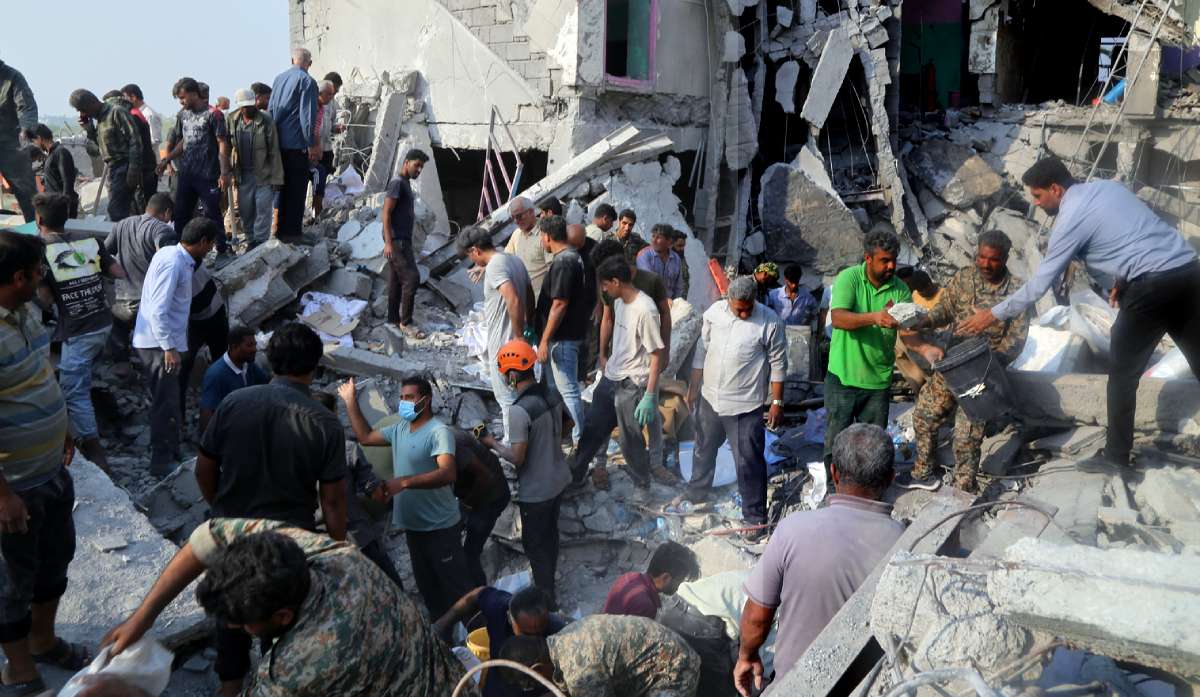
A US Tomahawk strike killed 168 (up to 175) children and 14 teachers at a public elementary school in Minab, southern Iran, on February 28, 2026. The kids were aged 7 to 12. The US is responsible. Trump said it was Iran.
The attack hit the Shajareh Tayyebeh (Shajare Tayyiba) elementary school, a girls’ primary institution, during morning classes. The Iranian Education Ministry and local authorities described the building as completely destroyed, with additional injuries reported in the dozens to nearly 100.
The strike occurred amid broader US and Israeli operations launched that day, which included attacks on Iranian military targets, particularly those linked to the Islamic Revolutionary Guard Corps (IRGC).
Double-tap strike
The strike was a so-called double-tap strike. After the first hit, a second missile hit the same area. A double-tap strike is a military tactic, often executed via drones or airstrikes, in which a target is hit with an initial attack, followed by one or more subsequent strikes on the same location shortly afterwards, typically within minutes to hours.
The second strike frequently occurs after survivors, rescuers, first responders, or additional personnel have arrived at the site.
This practice has been documented in U.S. operations primarily in counterterrorism contexts, such as in Pakistan, Yemen, Somalia, and Afghanistan. The rationale behind U.S. double-tap strikes, as employed in drone campaigns, appears to centre on maximising the elimination of suspected militants or ensuring the destruction of the initial target.
Confirmed: A double-tap US Tomahawk strike killed scores of children at a public elementary school in Minab, southern Iran, on February 28, 2026. At least 168 (up to 175) children and 14 teachers were killed.
In this video, the second missile hits. The smoke from the first hit is… pic.twitter.com/P4qyj3Vh2d— T. Sassersson, Editor@NewsVoice (@newsvoicemag) March 9, 2026
In some cases, it is described as a method to ”ensure that all individuals present in a ‘kill box,’ or designated area, are killed,” thereby preventing escape or recovery of key targets. This tactic also deters humanitarian aid or rescue efforts, as the fear of secondary strikes discourages civilians, medical personnel, or others from approaching.
The practice has been widely criticised as indiscriminate, potentially violating international humanitarian law (IHL) principles like distinction (separating combatants from civilians), proportionality (ensuring civilian harm is not excessive relative to military gain), and the prohibition on denying quarter (refusing to spare those rendered hors de combat, such as the wounded).
It has also been argued to constitute war crimes in certain contexts, particularly when it targets or foreseeably kills non-combatants like rescuers.
The practice did originate during the George W. Bush administration, with the earliest known strike in Pakistan dating to 2004 in the village of Dhok. The use of drones and double-tap strikes expanded dramatically under Barack Obama, who authorised ten times more overall drone strikes (563) in countries like Pakistan, Yemen, and Somalia compared to Bush’s 57.
Trump publicly blamed Iran
The school was located adjacent to, or in proximity to, an IRGC naval base or compound near the Strait of Hormuz, a strategically sensitive area. Satellite imagery analysed by multiple outlets showed the school and the military site had historically shared a compound before being separated by fencing, with recent imagery indicating activity in the school’s courtyard before the incident.
Investigative reporting, including from CNN, The New York Times, The Washington Post, and open-source intelligence groups like Bellingcat, points strongly to US responsibility.
Key evidence includes:
- Geolocated videos, including footage released by Iran’s Mehr News Agency and verified by Western media, show what experts identified as a US Tomahawk cruise missile striking the area. The Tomahawk, a ship- or submarine-launched precision-guided weapon, is used exclusively by the US military in this conflict.
- Visuals depicting near-simultaneous or closely timed impacts on the naval base and the school, with smoke rising from both sites.
- Assessments from munitions experts, such as N.R. Jenzen-Jones of Armament Research Services, indicate precision-guided munitions consistent with US capabilities, rather than Iranian air defence misfires.
- US official statements confirming strikes on southern Iranian naval targets to degrade IRGC capabilities along the coast, though without directly addressing the school.
The US military, through Central Command (CENTCOM) and the Defence Department, has acknowledged awareness of civilian harm reports and launched an investigation.
US officials, including Defence Secretary Pete Hegseth and Joint Chiefs Chair Gen. Dan Caine, have emphasised that American forces do not target civilians and are examining potential intelligence or targeting error, possibly a failure to update target data or misidentification amid the adjacent military site.
The White House has not ruled out US involvement. President Donald Trump has publicly blamed Iran for the school strike, claiming it was an Iranian action (such as a misfired missile), an assertion contradicted by the emerging evidence from videos, imagery, and expert analyses showing US munitions.
Israel has denied conducting operations in the southern area, focusing its strikes farther north.
The incident has drawn sharp international condemnation. UN human rights chief Volker Türk expressed ”significant concerns” about compliance with international humanitarian law, while UN spokeswoman Ravina Shamdasani called for accountability to prevent the tragedy from fading from attention.
Human rights groups and UNESCO have labelled it a grave violation and a possible war crime.
The strike stands as the deadliest known civilian casualty event in the conflict so far, highlighting the risks to non-combatants in densely populated or dual-use areas during military operations.
Sources
- New York Times: Analysis Suggests School Was Hit Amid U.S. Strikes on Iranian Naval Base
- Washington Post: Video appears to show US Tomahawk hit naval base near Iranian school
- CNN: Analysis suggests US was responsible for deadly strike on Iranian elementary school
- Bellingcat: Video Shows US Tomahawk Missile Strike Next to Girls’ School in Iran
- NPR: Video appears to show U.S. cruise missile striking Iranian school compound