

United Nations officials have warned that the ongoing disruption to shipping through the Strait of Hormuz risks triggering a global food crisis, with fertiliser supplies stalled at a critical time for spring planting. The conflict in Iran has also driven a surge in jet fuel prices, prompting airlines to raise fares by up to 20% and cut thousands of flights.
The narrow waterway between Iran and the Arabian Peninsula normally carries about one-third of global seaborne fertiliser trade, 35% of crude oil shipments and around a fifth of liquefied natural gas. Tanker traffic has collapsed by more than 90% since late February, according to UN data, creating ripple effects across energy markets and agricultural supply chains.
Jorge Moreira da Silva, executive director of the UN Office for Project Services, told UN News the situation was ”very significant and severe, particularly for the poorest countries and for the poorest citizens”.
The planting season in much of Africa is already underway, with the window closing in May.
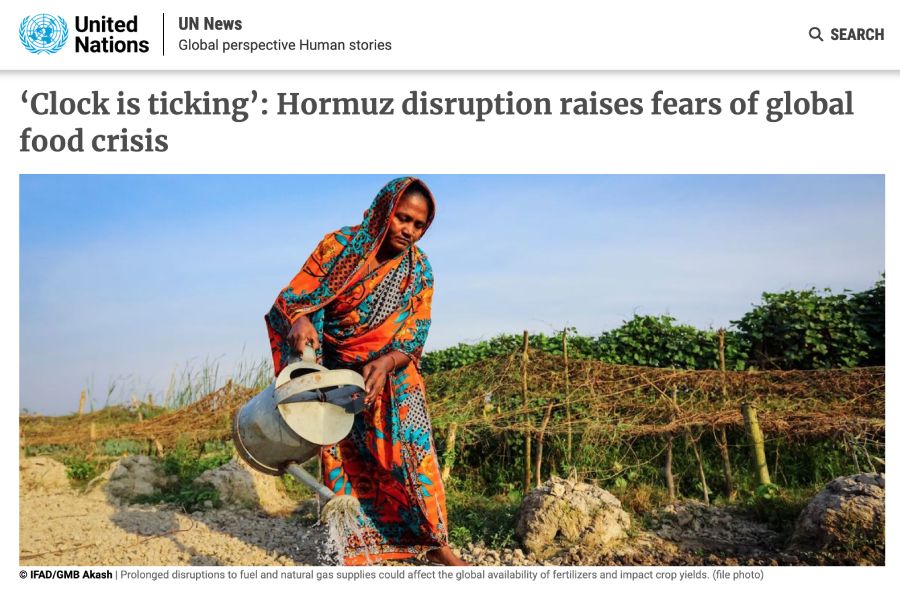
The UN World Food Programme estimates that prolonged disruption could push an additional 45 million people into hunger and starvation. Countries such as Sudan, Somalia, Mozambique, Kenya and Sri Lanka, already facing humanitarian pressures and heavily reliant on imported fertiliser, are among the most vulnerable.
Fertiliser prices have risen sharply. Global urea costs jumped 19-28% in the first weeks of the crisis, with further increases expected. FAO chief economist Máximo Torero has described the risk of an ”agrifood catastrophe” if vessels carrying farm inputs do not resume passage soon, warning of lower crop yields later this year and into 2027.
Everyday impact – Higher food bills and empty shelves ahead
For ordinary citizens, the effects are likely to be felt first in supermarkets. In the UK and other importing nations, grocery prices for staples such as bread, rice and meat could rise noticeably by autumn as reduced fertiliser use hits harvests.
Analysts say the shock mirrors the 2022 fertiliser price surge after Russia’s invasion of Ukraine, but on a potentially larger scale because of the volume of trade affected.Families in developing countries face the greatest risk.
In parts of Africa and South Asia, farmers may be forced to cut back on fertiliser, leading to smaller harvests and higher local food prices.
The UN has proposed a time-limited humanitarian channel for fertiliser shipments, which could be operational within days if warring parties agree. Energy costs are also climbing.
Higher oil and gas prices feed through to transport, heating and manufacturing, adding to broader inflationary pressures flagged by the European Central Bank and others.
Airlines respond with fare hikes and flight cuts
The fuel crisis has hit aviation particularly hard. Jet fuel prices have roughly doubled since late February, according to industry reports.
On 22 April, United Airlines chief executive Scott Kirby told investors the carrier may need to increase ticket prices by 15-20% to recover the full rise in costs ”as quickly as possible”. The airline has already raised fares multiple times and trimmed its 2026 flying capacity by about 5%.
Other carriers are following suit. Lufthansa is cancelling around 20,000 short-haul flights through October to save fuel, while KLM, Cathay Pacific, Air Canada and several others have reduced schedules or suspended routes. Industry analysts say global aviation capacity for May is down roughly 3%, with many less-profitable or fuel-intensive flights grounded.
Holidaymakers and business travellers could face higher costs and fewer options this summer. Families planning European city breaks or long-haul trips may see prices jump, while some routes, especially short-haul or lower-demand ones, disappear altogether. Baggage fees have already risen at several airlines.
Outlook uncertain
A fragile ceasefire and partial reopening of the strait were reported in mid-April, but renewed tensions and lingering supply-chain damage mean prices remain elevated and full recovery could take months.
The UN is leading efforts to secure safe passage for fertiliser and raw materials. Russia has extended export quotas on mineral fertilisers, and the European Union is preparing an action plan to boost domestic production. US officials have described reliance on imported fertiliser as a national security issue.
Economists warn the combined shocks to food and energy could shift the global outlook from inflation concerns to broader risks of slower growth or even rationing in extreme scenarios.
For millions of households worldwide, the message from the UN is clear: the clock is ticking. Without swift resolution, this year’s harvest, and next year’s dinner tables, could look very different.
Sources
- UN: ‘Clock is ticking’: Hormuz disruption raises fears of global food crisis
- Fortune: A global food emergency: Why the closed Strait of Hormuz puts half the world’s calories at risk
- Al Jazeera: World faces food ‘catastrophe’ if Strait of Hormuz disruption persists: FAO
- Reuters: United Airlines says fares may need to rise up to 20% to offset fuel surge
- S&P and Global: US gasoline prices fall on Hormuz opening, remain elevated against pre-war levels
- NPR: Jet fuel supplies are sharply affected by the near-closure of the Strait of Hormuz
- Fox News: Major airline axes 20,000 ’unprofitable’ flights as jet fuel costs soar
- Epoch Times: UN Warns Hormuz Disruption Could Trigger Food Crisis as Fertilizer Supply Stalls
- Epoch Times: United Airlines Says Ticket Prices May Rise by up to 20 Percent to Offset Jet Fuel Surge
- FAO: FAO Chief Economist warns of severe global food security risks from disruption to Strait of Hormuz trade corridor