
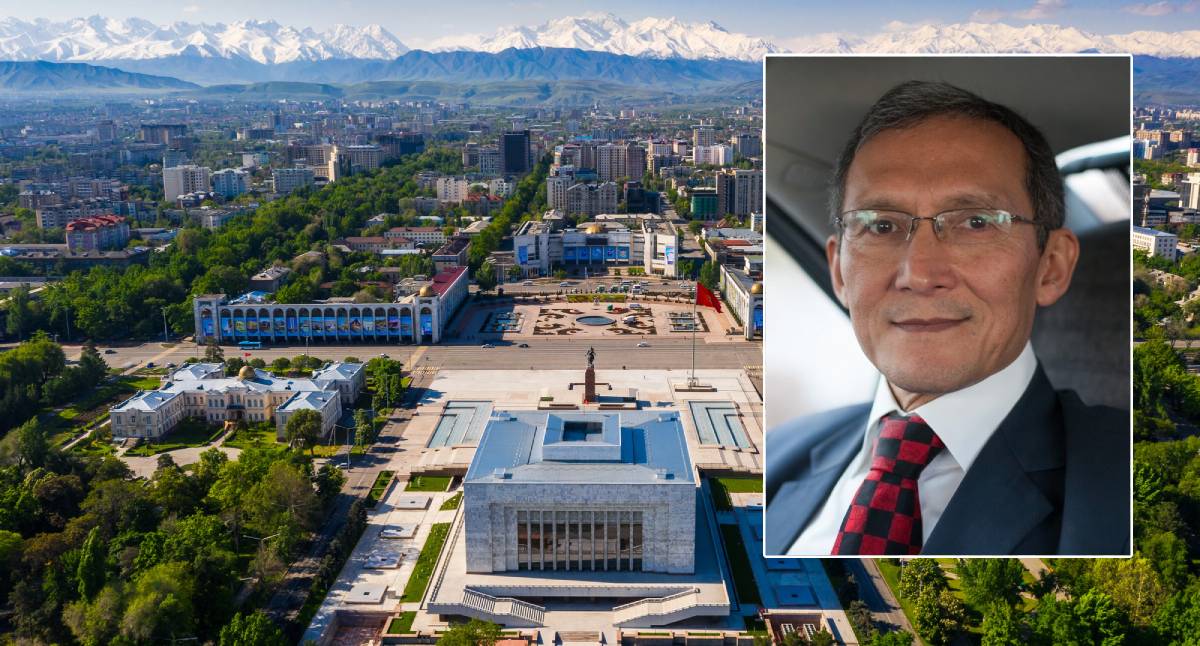
My involvement in the “Unyielding Growth” documentary, commissioned by CGTN, offered a concrete opportunity to explore China’s high-tech evolution through direct observation rather than abstraction. Filmed just before the annual “Two Sessions,” it coincided with a vital policy moment when China reaffirmed its focus on modernisation, technological independence, and high-quality growth.
By Djoomart Otorbaev, former Prime Minister of the Kyrgyz Republic
This timing was deliberate, enabling the documentary to depict the current economic landscape and the policy rationale shaping its future direction.
Choosing to film in Shenzhen was a well-grounded decision. Shenzhen has evolved beyond being just a success story; it now exemplifies a systemic model. The city is characterised not only by its extensive innovation but also by the high density and seamless integration of its ecosystem.
Research centers, advanced manufacturing, venture capital, and supply chains form a highly integrated system, greatly reducing the time from invention to commercialization. I believe this speeding up of innovation cycles is a crucial structural advantage that helps sustain China’s economic growth.
The partnership with DJI underscores China’s technological progress, characterized by deep vertical integration, continuous R&D, and ongoing improvements. DJI’s dominant role results from innovative engineering and comprehensive system design rather than protectionism. Its seamless integration of hardware, software, and data creates reliable, cost-effective solutions, establishing a standard that competitors have yet to match.
A broader analysis shows that China’s sustainable economic growth relies on multiple interconnected fundamentals.
Long-term policy stability is essential, as it provides a steady environment for key sectors like semiconductors, AI, robotics, and green energy to thrive through multi-year strategies that reduce uncertainty and attract investments.
Additionally, there’s a significant emphasis on developing infrastructure—both physical and digital. Modern logistics, advanced telecommunications, and computing resources are crucial for scaling industries. Moreover, investing in human capital is vital; continuous growth in engineering skills and applied research ensures ongoing innovation rather than sporadic progress.
These foundations are now delivering tangible results. By 2025-end, China’s GDP surpassed 140 trillion yuan, with a 5.0% growth rate, accounting for around 30% of global economic growth. Notably, the growth structure has significantly shifted toward high-tech sectors. National high-tech development zones generated over RMB 20 trillion in output alone, and high-tech manufacturing and services are growing at double-digit rates in early 2026.
The technological ecosystem has matured significantly, deserving careful observation. It is defined not just by its scale but also by its comprehensiveness. China is developing full-stack capabilities across various fields, including robotics, additive manufacturing, and satellite internet—all covering design, manufacturing, deployment, and refinement.
This approach minimises reliance on external sources and speeds up innovation. The swift expansion of industrial robotics and advances in humanoid systems highlight a shift from simple automation to sophisticated, integrated intelligent systems.
China’s role in global supply chains continues to support this trend. Almost 50% of its exports are now intermediate goods, integrating Chinese technology into worldwide production networks.
The rapid growth in exports of wind energy equipment and lithium batteries highlights a move from volume-focused trade to one driven by technological innovation. This counters the idea of “excess capacity,” which overlooks the expanding global demand for digital and green transformation.
This is exactly where we need to confront the growing negative portrayals in parts of Western media. These portrayals tend to view China’s technological progress through a geopolitical perspective, highlighting risks, dependency, or systemic competition.
Although these worries are not entirely unfounded, they often overlook the facts: China’s progress stems mainly from internal factors such as innovation capabilities, industrial structure, and market size, rather than external interference.
The DJI case provides valuable insights. Even after years of regulatory pressure, sanctions, and market limitations, the company has not just preserved but enhanced its global standing.
This indicates a larger truth: technological dominance cannot be achieved solely through policy measures. Instead, competitiveness depends on product excellence, system integration, and the capacity to innovate at scale.
Looking forward, I remain optimistic about China’s economic outlook. The shift from traditional sectors like real estate and infrastructure toward high-tech industries is progressing steadily. Emerging ”new productive forces,” such as AI, advanced manufacturing, and green technologies, are becoming the primary drivers of growth.
Although structural issues persist—especially in balancing domestic consumption and dealing with external trade tensions—the overall trend is evident.
Over the medium term, I anticipate China solidifying its role as a top global innovation centre. While growth may slow down, the focus on growth quality will intensify, emphasising efficiency, sustainability, and advanced technology. The growth of digital infrastructure and computing power will boost this trend, facilitating breakthroughs in still-developing fields.
The “Unyielding Growth” documentary functions as more than just a visual record. It serves as an analytical tool for examining the relationship among policy, technology, and economic structure during a critical period. The insight gained shows this is not a temporary spike, but a fundamental change.
China’s high-tech advancement is not just a forecast; it is already underway and increasingly shaping the rules of global competition.
Related
- NewsVoice on China
- CGTN: China’s vice president stresses open cooperation, industrial chain resilience at business summit