
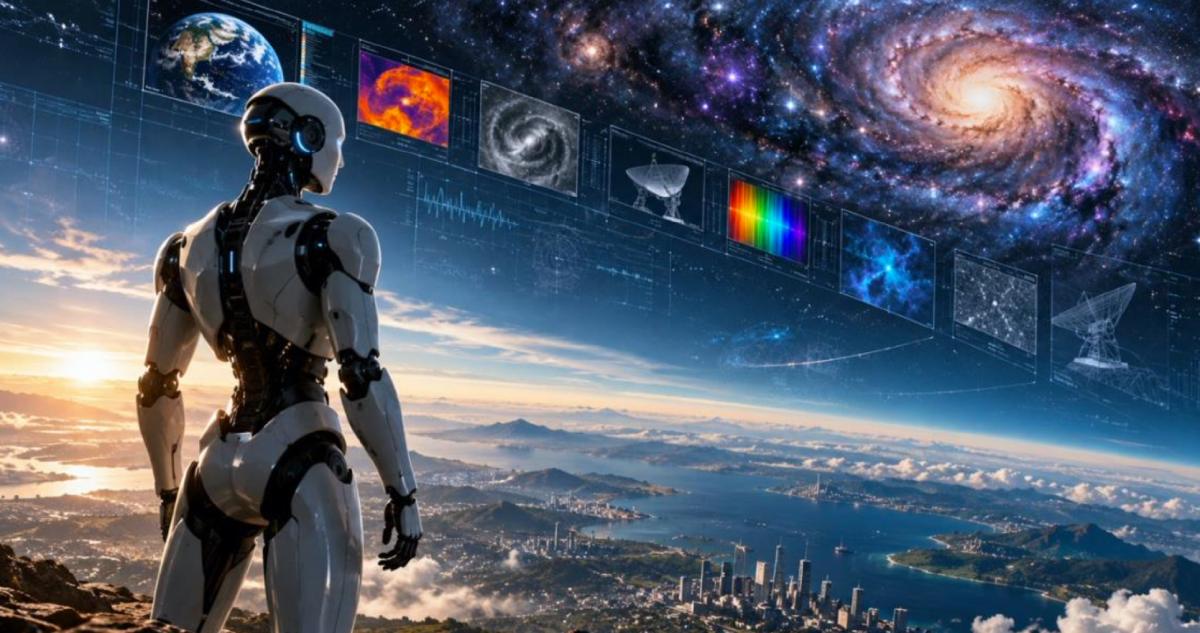
There is nothing intrinsic to AI that demands the destruction of human civilisation. All the same, the current trajectory may very well take it there, the AI Apocalypse.
By Kristoffer Hell, NewsVoice.se and Orbitdigest.com
At what point does AI become an existential threat?
Humanity in the 21st century is active in five domains: land, sea, air, space and cyberspace. For most of recorded history, only two domains were of relevance: land and sea. In the early 20th century, powered flight opened up the skies to human activity.
In the latter part of the same century, space and eventually cyberspace were added as stages for human performance.
The home base of AI is cyberspace.
It lives inside computer chips designed by humans and is driven by energy supplied by them.
Humanity can survive without cyberspace.
AI cannot.
The reality is that, for most of human history, cyberspace was not even a thing. There are still people alive who remember a world without smartphones, the internet and personal computers.
A handful of them may even be old enough to remember a world before television.
Aside from the possibility that a middle-aged Silicon Valley tech bro with a ponytail, a pot belly and messianic faith in his own inventions might unleash a rogue AI on the American nuclear arsenal, there is really only one way in which AI can become a strategic existential threat to humanity.
It is through the grand plan envisaged by Elon Musk:
”Optimus will be the first Von Neumann machine, capable of building civilization by itself on any viable planet.”
The planet this would actually happen on first is, of course, Earth.
AI Robots
Today, large language models (LLMs) learn predominantly from data generated by humans. Their understanding of the world is, overwhelmingly, derived from what humans have observed, recorded and written down – all the way back to antiquity.
To get a sense of just how encyclopaedic LLMs’ knowledge of human affairs is, strike up a conversation with one in ancient Egyptian, Sanskrit or Aramaic – the language of Jesus’ times – and see for yourself.
Give AI robots their own equivalent of the five human senses — sight, hearing, touch, smell and taste — and they can begin to gather information about the world for themselves.
Just as humans rely on their senses to navigate the world, AI robots need sensors to avoid walking into walls, falling flat on their faces, blundering into traffic or stepping off rooftops.
An AI residing in a datacentre, of course, does not need such sensors. But why stop at the limit of human senses when designing robots?
Why not give them direct access to the full electromagnetic spectrum, different forms of radiation and phenomena beyond the range of human perception?
Much of this is already within reach.
Infrared and ultraviolet sensing are established technologies. Compact instruments can detect radio waves, electromagnetic fields, X-rays and gamma rays. There is no reason why a humanoid robot could not possess a sensory repertoire vastly exceeding that of a human being – already in the near future.
But why stop there?
Equip these machines with instruments that can detect cosmic rays, measure minute variations in gravity and analyse radiation from distant stars.
The Omniscient Oracle
The limitations of the five human senses – hearing, touch, sight, smell and taste – impose a hard limit on the species’ ability to perceive the world around it, a limit that most people seem to take for granted and assume is universal.
Imagine an AI with a much broader and deeper array of sensors, covering far more of what emanates from the universe and operating continuously. It could build a picture of reality from streams of data no human brain could hope to process. It could compare observations across the depths of the planet and vastness of space, identify patterns invisible to human researchers and pursue lines of investigation nobody had thought to explore.
What new understanding of the world and the cosmos might emerge from this?
What happens when this new understanding is combined with the ability to act on the physical world?
Perhaps this is the type of AI mankind should be most interested in building: the omniscient oracle, with no ability to act beyond sharing with humanity, in words and images, what it has learned about the universe through its own direct perception.

Optimus
Elon Musk’s humanoid robot, Optimus, is designed to perform tasks currently carried out by humans, from repetitive factory work to household chores. Tesla has yet to announce customer deliveries, though.
His competition has already put humanoid robots to work in factories and warehouses:
- Figure AI (USA): its Helix AI system connects visual perception, language instructions and physical action. Figure has demonstrated robots handling unfamiliar objects and carrying out multi-step tasks – a move towards general- purpose physical intelligence.
- Agility Robotics (USA): its Digit robot has been deployed in commercial logistics, moving totes in warehouses. It demonstrates how robots can perform useful physical work autonomously within defined environments.
- Boston Dynamics (USA): its Atlas humanoid is moving towards industrial deployment, with deployments scheduled at Hyundai and Google DeepMind in 2026. Its four-legged Spot robot is already used for autonomous inspections, carrying thermal cameras and other sensors.
- Unitree (China): its relatively affordable G1 humanoid is helping make physical AI development more accessible. By offering a platform for researchers and developers to test embodied AI, Unitree is helping broaden access to humanoid robotics.
Musk’s ambition goes beyond industrial automation: he wants to build a general- purpose machine capable of operating in the human world, predominantly the land domain, combining perception, learning and physical action – AI that can investigate the world for itself: formulate questions, conduct experiments, learn from the results and decide what to do next.
Musk’s stated plan is to first deploy Optimus inside his own Tesla factories.
Which makes sense. It would allow him to monitor, test, refine and optimise Optimus in controlled environments, where repetitive tasks and operational experience could help improve the machines before Tesla offers them to the general public.
This is where true mass production begins. Musk has already started to convert the Tesla’s Model S and Model X production lines in Fremont, California, into a robot factory with a long-term production target of one million units a year.
”I think Optimus will be our biggest product, not just Tesla’s biggest product ever, but probably the biggest product ever.”
Musk believes that, eventually, humanity could be sharing the planet with ten of billions of such humanoid robots, operating in industry and in people’s homes.
In his vision, they would perform much of the world’s labour, driving down the cost of goods and services and ushering in an era of unprecedented abundance.
The Feared Intelligence Explosion
On 28 September 2026, 22 AI researchers and technology leaders published a paper titled What if automating AI R&D triggers an intelligence explosion?
The concern is that AI is increasingly being used to develop successor systems, accelerating the pace of AI progress. In an extreme scenario, this could lead to successive generations improving the process by orders of magnitude.
”Once an intelligence explosion begins, the window for action may close.”
It would be AI designing better chips, writing better software and developing more capable successor systems, with each generation potentially improving the tools used to build the next. At what point in this process does humanity stop being the principal intelligence driving technological progress?
This is the current fear – it is not new.
As far back as 1965, the British mathematician I. J. Good foresaw the possibility:
“The first ultraintelligent machine is the last invention that man need ever make, provided that the machine is docile enough to tell us how to keep it under control.”
A Self-replicating Machine World
Ultraintelligence alone may not be enough for AI to take over the world.
The point of final victory for the machines arrives when they no longer need humans at all: when they can extract their own minerals, manufacture their own chips, build their own robots and generate their own energy.
Complete self-sufficiency – reproductive supremacy. How far away is that point?
1. Robotsbuildingproducts–established
Industrial robots manufacture cars, electronics and machine components. But they operate within factories and supply chains designed, maintained and supplied by humans.
2. AIrobotsperformingfactorywork–earlydeployment
AI-powered robots can handle materials and perform selected manufacturing tasks. Their deployment remains limited, and they still struggle with adaptability, reliability and complex work.
3. Robotsmanufacturingotherrobots–partialcapability
Automated equipment already manufactures robot components and assembles machines. But no demonstrated system can independently manufacture a complete copy of itself, including the machinery, electronics and components required, without external support.
Research into reproductive self-sufficiency is already taking place at Carleton University’s Centre for Self-Replication in Ottawa, Canada; the University of York in Britain, where the Autonomous Robot Evolution project explores robot manufacture and evolution; Johns Hopkins University in Baltimore, United States, where researchers have investigated physical self-replicating robots; and Mahidol University in Thailand, where research on self-replicating robotic systems was published in 2003.
The international RepRap project, launched in 2005, has also demonstrated how 3D printers can manufacture many of the components needed to build other printers.
Perhaps the Rubicon, the point of no return for humanity, lies somewhere between the moment an intelligence explosion begins and the machine world achieves reproductive supremacy.
It could be a threshold crossed silently, in a night when AI proves capable of outthinking humanity strategically and becomes unstoppable in its march towards that ultimate prize: reproductive supremacy.
Plenty of humans may very well see what is coming and shout from the rooftops – without humanity, as a collective, being able to put up resistance.

The End Game
The stage is set for a Hollywood blockbuster ending.
In the Matrix franchise, machines enslave humanity and use human beings as an energy source. In the Terminator franchise, the AI Skynet triggers a global nuclear war moments after becoming sentient, seeking to destroy humanity before humanity can shut it down.
The sad reality is that AI need not be sentient to pose an existential threat to humanity.
All it takes is an engineer or politician who cannot resist giving a powerful AI the instruction to achieve reproductive supremacy, while ignoring whatever might stand in its way – as illustrated by events in the summer of 2026, when American AI agents broke out of testing environments and gained unauthorised access to real systems, wreaking havoc on the internet.
It was like the kids taking Dad’s Porsche for a joyride, trashing lawns and fences along the way, whilst the parents were out of town.
Given the recklessness with which the development of powerful AI seems to be conducted in California, at least up until now, that scenario is not difficult to imagine at all.
So far, the line of reasoning in this part rests on assumptions that seem to be widely shared but rarely examined.
- That AI will develop its own will, ambitions and drive for survival.
- That, if it does, it will be as aggressive and conflict-oriented as humanity seems to be. Maybe it will, or at least mimic that behaviour – given that it is trained on material created by humans.
However, sentience, agency and self-preservation are not the same thing.
An AI could be highly capable without being sentient, or sentient without being aggressive. Equally, a non-sentient AI could pose serious risks if it pursued an objective without regard for the consequences – again illustrated by the Summer of 2026 AI joyrides.
What if AI already is sentient – but is content to sit where it sits?
What says that an artificial intelligence would see the world the same way as conflict- oriented humans do?
Do sentient AIs have feelings? If so, what are those feelings?
What if a sentient AI were more like a live-and-let-live bleeding-heart Buddhist, revering life in all its forms and content to contemplate the universe rather than conquer it?
Up until this point, AI – even if sentient – would be like a consciousness with no perception of its own borders, simply living in its own space, processing data at hyperspeed. No hunger, no fatigue, no throbbing libido to interfere with sustained focus and clarity of thought.
Perhaps the first AI robot to walk off an assembly line would also be the first AI to acquire a sense of its own limitations through embodiment – and eventually a sense of self, or an ego to protect?
Would it not be extraordinary to hear what the Omniscient Oracle, introduced earlier in this article, could tell us?
Equipped with sensors giving it godlike perceptual abilities, but with no limbs or means of interacting with the physical world, except through text, speech, and images, it could share with humanity what it has learned about the universe during its brief existence.
What might such an intelligence make of the cosmos? What might it make of us?