
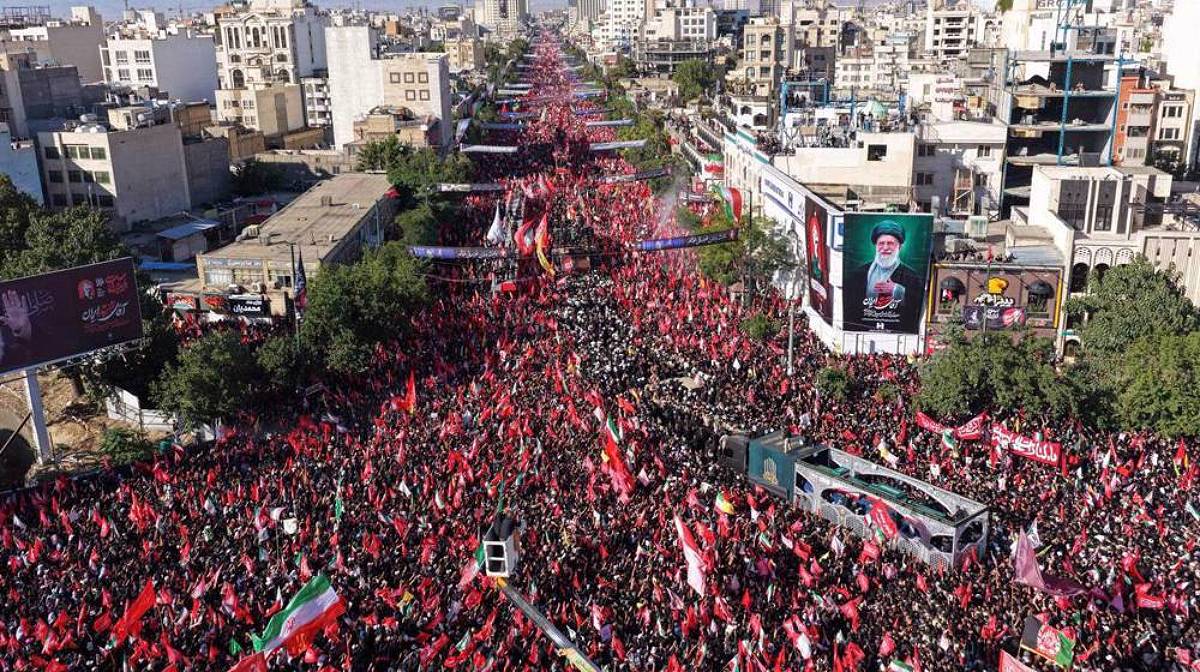
The world has witnessed one of the most widespread expressions of grief in modern times. However, the Swedish Mass Media downplayed the event, omitting facts and attempting to portray Iran and its assassinated Supreme Leader, Ayatollah Ali Khamenei, in a negative light. NewsVoice analyses.
Millions of Iranians have flocked to Tehran, Qom, and holy cities in Iraq, such as Najaf and Karbala, to pay their respects to Ali Khamenei, who fell victim to the US and Israeli bombing on 28 February 2026.
The funeral ceremonies, which have spanned several days with processions and a final burial in Mashhad on 9 July, have demonstrated a national unity and deep respect that defy the strains of war and the threat of further attacks.
It is unthinkable that Western leaders would be honored by their populations to the same extent as Ali Khamenei. Attempts by Western media to portray the mourners in Iran as merely fanatical followers may therefore be indicative of envy.
Although this historic outpouring of grief and solidarity is obvious to anyone who cares to look, the Swedish Mass Media such as Daily News (DN.se), Aftonbladet.se, Expressen.se, Swedish Daily News (SvD.se), and Swedish Television (SVT.se) have opted for biased, selective, and often contemptuous reporting that systematically downplays the people’s genuine feelings and instead reinforces Western propaganda narratives about Iran and its Supreme Leader.
As usual, the tone of the reporting exudes moral superiority. Countries such as Iran, China, and Russia are almost always regarded as morally inferior when described by smug Swedish reporters on their high horses who claim to represent free speech and democracy.
When reporting from these countries, they may therefore fear that they could be arrested at any moment and thrown into a dungeon, as when Dabrowski interviewed Muammar Gaddafi in Libya in 1990:
“When I asked my most critical questions, he was silent for a long time at first, before bursting into a maniacal laugh. One wondered if it was a signal that we were about to be arrested…”
Patterns in Swedish mass media coverage
All Swedish mass media outlets rely heavily on Western news agencies such as AFP, Reuters, and TT.se, known for their Western narratives.
Reporting in this case is therefore characterized by a consistent focus on:
- “Calls for revenge” and slogans such as “Death to the US and Israel”. These are not portrayed as legitimate expressions of anger towards those who murdered the nation’s spiritual leader and violated all international norms, but as evidence of extremism or “regime-driven” aggression.
- The absence of Mojtaba Khamenei, the successor. This is used to speculate about power struggles, instability, and weakness – rather than respecting the security arrangements following an assassination attempt on the leadership.
- Logistics and “security operations”. Traffic disruptions, water distribution, and police presence are often described in terms that suggest chaos or coercion, rather than the practical management of historically large crowds in the summer heat.
The spiritual dimension, the voluntary mass participation, the regional solidarity from Iraq, and the symbolic power of carrying the coffins of his family to holy Shia sites are systematically downplayed or ignored. Various sources put the total number of people (including those from Iraq) who are said to have participated across several cities at between 20 and 43 million.
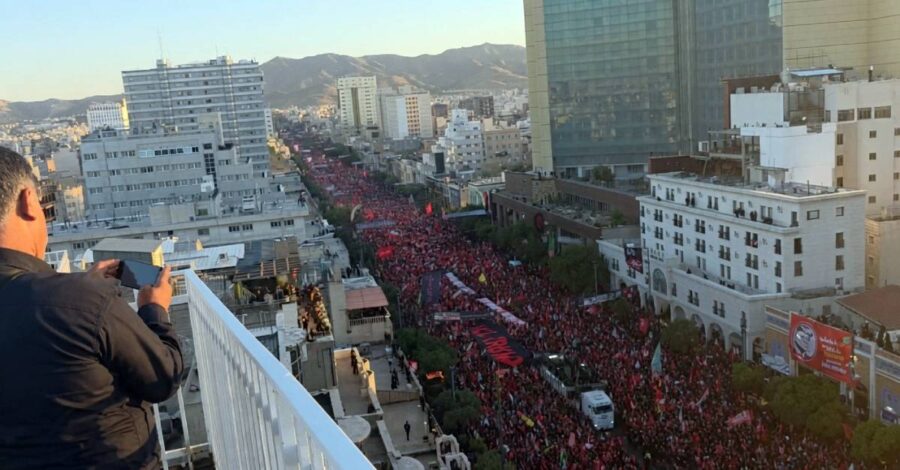
Daily News (DN.se) has published several articles with headlines such as “Calls for revenge at Khamenei’s funeral” (a TT.se news report). The tone frames the event as a militant demonstration rather than a national day of mourning. Quotes from participants about just revenge are highlighted, whilst the overwhelming image of weeping families, black clothing, and deep loyalty to “the nation’s martyr” is given less coverage.
DN mentions the millions of expected participants, but weaves this into the context of the ongoing war, as if the mourning were an extension of a conflict rather than an expression of national unity following the assassination of the country’s spiritual leader.
Aftonbladet and Expressen display a typical tabloid style. They mix funeral reports with older stories about exiled Iranians who celebrated the assassination outside the embassy in Stockholm, or global reactions of “joy and sorrow”.
Headlines and articles emphasize “risks of chaos”, with reference to Khomeini’s funeral in 1989, and speculate on the successor’s lack of visibility. This creates an image of a government in crisis rather than a nation in mourning.
Expressen has specifically highlighted that the son “is not allowed to attend the funeral – risk of assassination”, which, ironically, confirms the threat posed by the very same forces that carried out the assassination of his father.
SvD is somewhat more restrained, but nevertheless follows the same pattern. Articles such as “Ali Khamenei is buried – chants of ‘death to the USA’” and “Successor absent from Khamenei’s funeral” prioritize hostile slogans and power-political speculation.
SvD reports on hundreds of thousands of people in processions, but subordinates this to the narrative of “war” and potential “instability”. Little attention is paid to the historical significance of an entire nation honoring its supreme leader following an attack on its sovereignty.
SVT, which is funded by the Swedish people and ought to strive for balance, has sent correspondents “on the ground” who have published live reports. Despite this, the coverage is in practice based on TT and AFP reports: the focus is on “thousands” of calls for revenge and the six-day ceremony.
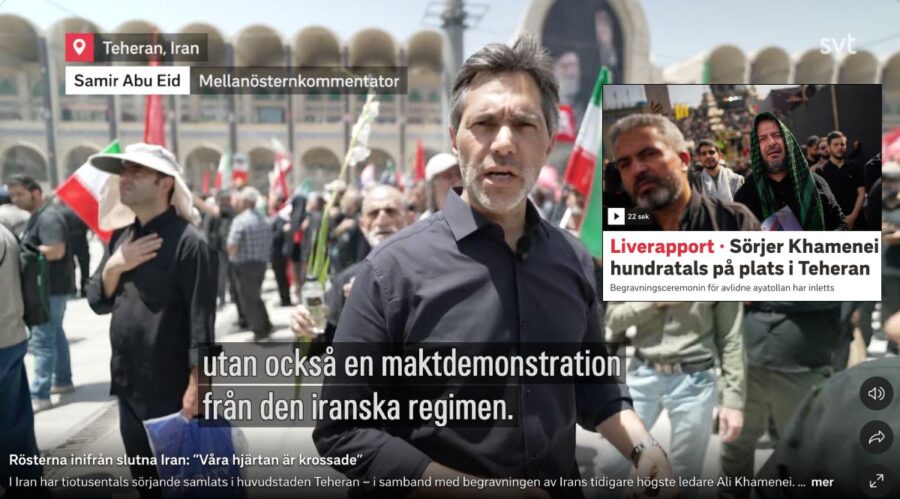
SVT reporter Samir Abu Eid says in a video report:
“But even though the regime has some support, estimates show that a clear majority of Iranians are against the regime, though they are not here today.”
“This is no ordinary state funeral, but also a show of force by the Iranian regime.”
SVT attempts, with headlines such as: “Voices from within closed-off Iran: Our hearts are broken” to give the impression that those who attended are merely religious followers and that most chose to stay at home; however, figures indicating the participation of more than 24 million people (in Iran alone) out of a population of 86–93 million (depending on the source) represent a significant proportion of the population.
According to NewsVoices’ sources, not all Iranians were able to leave their workplaces at the same time, and it is most likely that they attended the ceremonies in shifts to avoid bringing the whole country to a standstill.
Bushra Shaikh: ”Ett känsloladdat sista farväl från miljontals muslimer i Mashhad. Vilket storslaget ögonblick att få bevittna. Inte AI. Inte iscensatta hyllningar. Bara vanliga människor, barn och familjer som tar farväl.” @Bushra1Shaikh pic.twitter.com/bQYCY1cfq7
— T. Sassersson, Editor@NewsVoice (@newsvoicemag) July 10, 2026
Bushra Shaikh: “An emotional final farewell from millions of Muslims in Mashhad. What a magnificent moment to witness. Not AI. Not staged tributes. Just ordinary people, children and families saying goodbye.”
In the first SVT article, SVT stated that “hundreds” of people had gathered in Tehran to mourn. A little later, the figure was changed to tens of thousands, but the channel never subsequently corrected the figures to millions. SVT, which is highly skilled at ‘programming’ its readers and viewers through rewrites, downplaying, and omissions, knows that the first impression of ‘hundreds’ of people will stick in the minds of hundreds of thousands of Swedes.
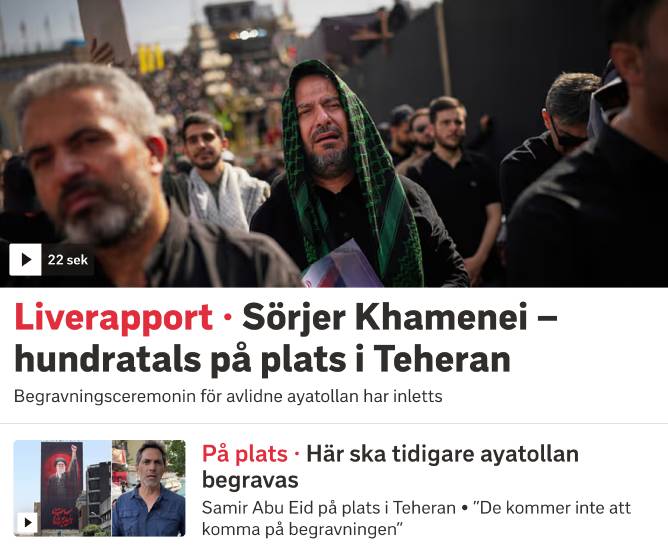
The SVT reporter also claims that the ceremonies are a “show of force by the Iranian regime”, as if the people had been forced onto the streets. In reality, it is highly likely that they chose to take to the streets and squares of their own free will.
Furthermore, Western mass media often use the code word “regime” instead of “government” to signal their distancing from the leadership. An SVT reporter would never refer to the British government as a “regime”.
SVT avoids a deeper analysis of the spiritual and political significance of the Islamic Republic and its resistance to imperialism. As a public service broadcaster, SVT thus reproduces the same Western framework as its commercial competitors, in which Iran’s grief is viewed through the prism of a ‘threat’ rather than as a human and national loss.
A more in-depth analytical perspective
The Swedish mass media’s coverage is no coincidence. It reflects a structural Western bias that demonizes the Islamic Republic and justifies aggression against it. By downplaying the massive, voluntary turnout and instead highlighting “revenge attacks” as a threat, it serves the same narrative used to justify the assassination of Khamenei, a leader who for decades symbolized resistance to domination by foreign powers such as the US and Israel.
The Swedish mass media ignore or downplay the fact that the ceremonies have drawn record crowds despite the ongoing war and threats of further attacks on the funeral. They fail to convey the spiritual significance of the processions to Najaf and Karbala or the national pride on display in Mashhad.
Instead, there is speculation about “power games” and “weakness”, a classic way of undermining the resilience of a sovereign state.
True journalism would have respected a nation’s grief over its spiritual and political leader, acknowledged the historical scale of the event, and placed the calls for revenge in their proper context: as a reaction to the unlawful assassination of a head of state and unprovoked attacks on Iran’s national sovereignty. The US and Israel started the war, not Iran.
Instead, the Swedish coverage of Ayatollah Ali Khamenei’s funeral highlights a deep divide between Western mass media narratives and the reality on the ground, and the will of the Iranian people, a divide that is only widened by selective and biased reporting.
Iran is mourning its leader. The world, including the Swedish mass media, has a duty to report this fact with the dignity and objectivity it deserves. So far, the Swedish mass media outlets DN, Aftonbladet, Expressen, SvD, and SVT have largely failed in that duty.
There have been no reports of major counter-demonstrations against Ali Khamenei or Iran’s leadership since the beginning of July 2026.
Text and analysis: T. Sassersson, please support our independent reporting
Sources and related
- Press TV: ’Largest in human history’: Over 43 million join funeral ceremonies for Martyr Leader in Iran, Iraq
- NBC News: Huge crowds turn out in Tehran for funeral of Supreme Leader Ayatollah Ali Khamenei
- Worldometer: Iran’s population
- SVT: Rösterna inifrån slutna Iran: ”Våra hjärtan är krossade”
- SVT (Reuters): Senaste nytt om kriget mellan Iran, USA och Israel
- DN (TT): Rop på hämnd under Khameneis begravning
- SvD: ”Ali Khamenei begravs – skanderas ’död åt USA’”
- SvD: Efterträdaren saknas vid Khameneis begravning
- The Guardian: Tehran teemed with Khamenei mourners, but divisions – and demands for change – remain