
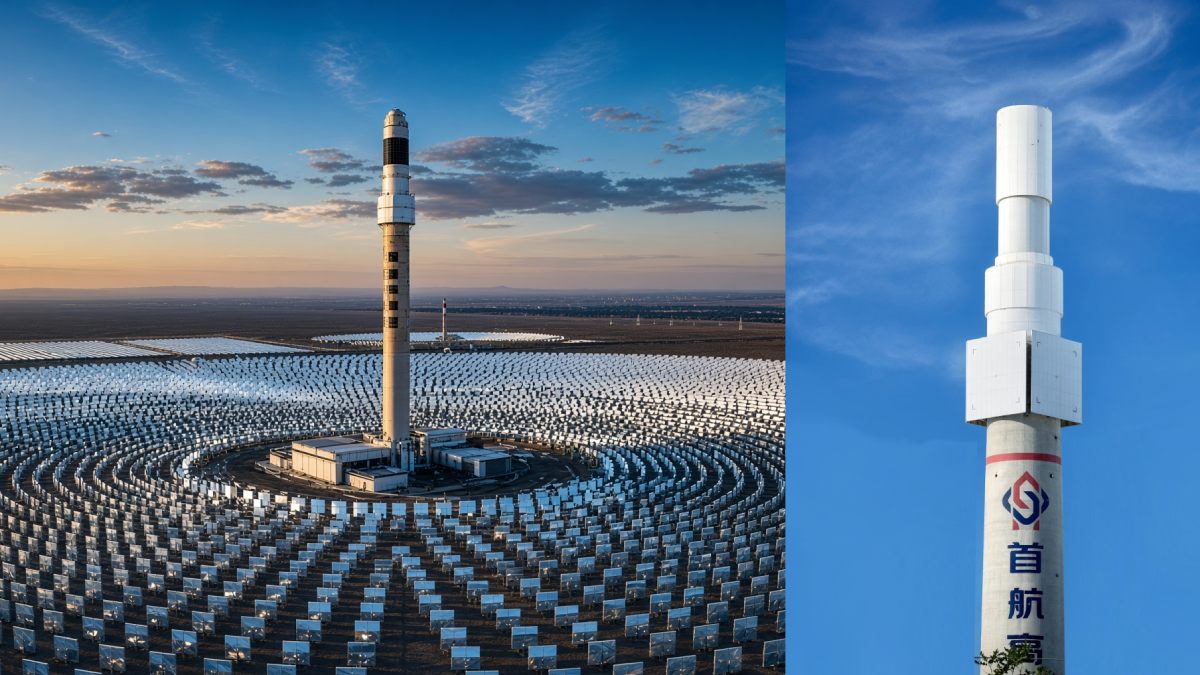
On the edge of the Gobi Desert, rows of photovoltaic panels and thousands of sun-tracking mirrors now form one of China’s most distinctive energy landscapes: the Dunhuang Photovoltaic Plant and expo park, also known as the Dunhuang Photoelectric Industrial Park.
Photos by Gogansu.com and Raoul Somers (Raoulsomers.com)
The park, launched in 2009 about 13 kilometers west of the Silk Road city of Dunhuang, was China’s first approved solar demonstration base above the million-kilowatt class. It covers a planned 254 square kilometers of Gobi land north of Qili Town and National Highway 215. Officials say more than 70 square kilometers have been built out, with 36 companies on site.
Approved solar projects in the park total about 2.03 million kilowatts (2.03 GW). Of that, 1.93 GW is already built and connected to the grid, with another 100 MW under construction. The long-term planned capacity is 5.5 GW. The site is described as Gansu’s earliest, largest contiguous, and highest-capacity photovoltaic industrial park.
Its purpose is both industrial and public-facing. Dunhuang receives more than 3,257 hours of sunshine a year and intense solar radiation, making the desert suitable for large grid-connected plants.
The park combines photovoltaic arrays with concentrated solar power, including Asia’s first molten-salt tower CSP plant and China’s first 100 MW-class molten-salt tower station. About 12,000 heliostats focus sunlight onto a 260-meter tower; stored heat in molten salt allows generation after sunset. Design figures for that 100 MW plant include roughly 390 million kWh a year.
The park is also a national 3A tourist attraction and Gansu’s only study-tour base that fuses new energy with education. Visitors walk among the arrays, see exhibition halls, and learn how “photovoltaic plus CSP” can supply dispatchable green power. Local officials say the site has become a stop on Dunhuang’s western tourism route, alongside the Mogao Caves and Mingsha Mountain.
The city itself reported a full year of 100 percent green electricity in 2025, drawing on solar, wind, and hydropower, with surplus power sent to other provinces. Dunhuang’s total installed generating capacity was reported at 4.34 million kilowatts, all from renewables.
Foreigners visited Dunhuang Photovoltaic Plant
A group of Europeans visited the park as part of a media and travel agents’ tour in the Ningxia and Gansu provinces in central China. The stop is typical of recent itineraries that pair Silk Road heritage with the region’s renewable-energy build-out, presenting the Gobi not only as desert but as a working “power bank” for the country’s carbon-peaking and carbon-neutrality goals.
The media personality Alex Outhwaite at A Life Well Travelled from the UK says:
”I think seeing the region utilising vast open spaces like within the Gobi desert for renewable energy is fantastic.
The dual tower system is the first of it’s kind and looked very futuristic as we drove by, but hopefully will only be the first of many.”
Park operators emphasize multi-energy complementarity, grid export along the west-to-east transmission corridor, and “new energy plus tourism.” For visitors, the spectacle is immediate: a sea of panels on the sand, and a circle of mirrors concentrating desert sunlight onto a single glowing tower.
Sources
- China Daily (subsite): Stunning post-rain scenery at Dunhuang photovoltaic industrial park
- CGTN: Power of Dunhuang: Gardening steel ’sunflowers’ in the Gobi Desert