
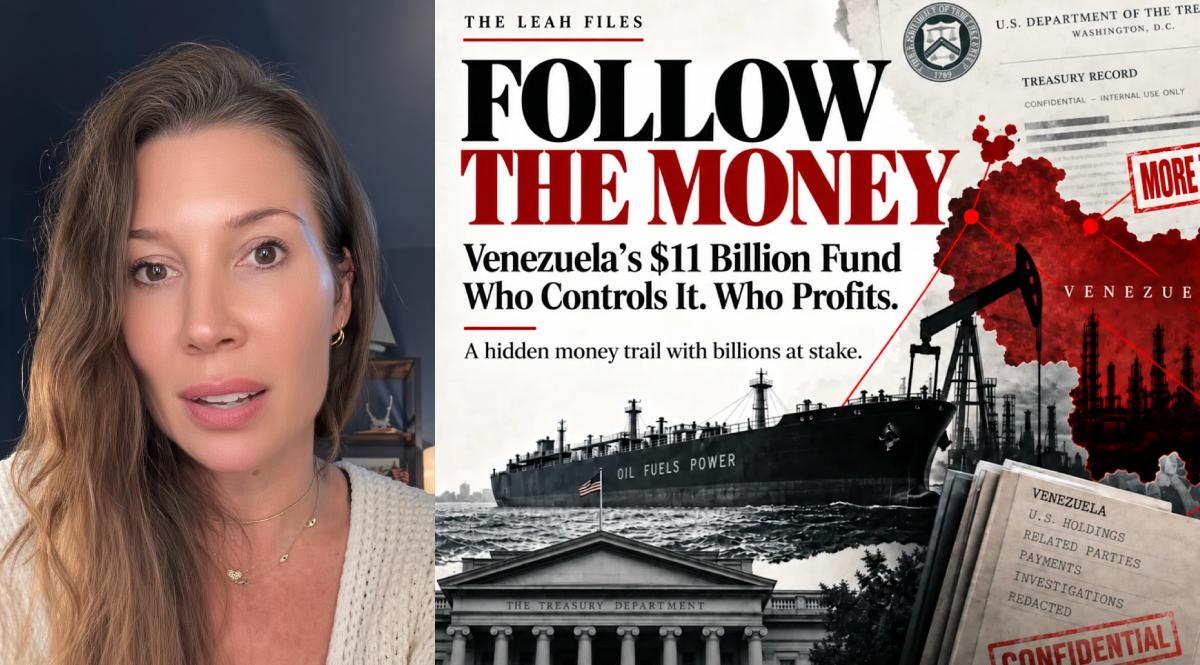
Independent researcher Renn Leah Pfeiffer, says Treasury data show more than $11 billion in extra deposits hitting a State Department line since February 2026, the same period Venezuelan oil money was moved onshore, while Treasury Secretary Scott Bessent refused at a House hearing to give a disbursement total.
Renn Leah Pfeiffer is a former federal consultant who spent 20 years supporting intel and DoD work. She began at Northrop Grumman building cost models for NGA, then worked through firms including Booz Allen Hamilton, PwC, KPMG, Grant Thornton, supporting clients such as NGA, NRO, DIA, CIA, NSA, IARPA, and the Senate. She later launched her own corporate intelligence practice and The Leah Files.
Pfeiffer’s post, “Follow the Money: How the U.S. Turned Venezuela’s Oil Money Into a Payday for Insiders,” starts with that hearing. Rep. Sean Casten asked how much Venezuelan-asset money had flowed through Treasury-controlled accounts since January. Bessent declined twice.
He called the holdings “one of the largest assets that maybe ever to go on the US balance sheet,” even though Executive Order 14373, signed Jan. 9, 2026, says the funds belong to Venezuela and are held only in a custodial capacity.
Using Daily Treasury Statement figures, Pfeiffer reports the State Department deposit line took in $14.7 billion from Jan. 1 through Sept. 17, 2026, about $11.4 billion more than the same stretch of 2025.
A State official told Congress roughly $3 billion had gone back for salaries and oil supplies; Venezuela’s own public tracker, she writes, shows $300 million. A KPMG audit contract has a ceiling of $84.4 million, with $5 million obligated and none paid, and no published audit. Venezuela must seek U.S. permission to spend the money.
She says the structure was designed to keep creditors away. Officials including Secretary of State Marco Rubio and Energy Secretary Chris Wright said putting the cash in a U.S. bank without protection risked seizure.
The January order voids court process against the funds. ConocoPhillips, owed about $12 billion after an arbitration win, was told by the president it was a “good writeoff,” according to her account of a White House oil meeting.
Treasury has also repeatedly renewed a license blocking holders of 2020 PDVSA bonds from taking Citgo shares and has not licensed a court-approved $5.9 billion Citgo sale.
Who she says is getting paidPfeiffer names Vitol and Trafigura as the traders handling the oil, noting both have recent U.S. bribery resolutions. Citibank holds the funds and, Bessent acknowledged, is likely collecting fees. Most of the related contracts, she writes, were not competitively bid.
The centerpiece of her report is a no-bid Pentagon arrangement announced Aug. 28. The White House said the Department of War took a free 35 percent stake in the parent of North American Blue Energy Partners, tied to Venezuelan businessman Alejandro Betancourt and 17 oil fields for 100 years.
Pfeiffer notes a Miami money-laundering probe around Betancourt was reported closed; the Justice Department denied that Deputy Attorney General Todd Blanche ordered that outcome. She also cites 2012 Epstein emails in which Francisco D’Agostino listed Betancourt among people Epstein should meet and later copied both men on an oil pitch. She stresses the emails do not show a completed deal or any link to Epstein’s sex crimes.
A separate thread follows banker Julio Herrera Velutini. After a 2022 bribery indictment, his daughter gave MAGA Inc. $3.5 million in two donations.
He later pleaded to a foreign-national contribution misdemeanor; the president pardoned him, former Puerto Rico Gov. Wanda Vázquez, and a former FBI agent on Jan. 15, 2026, after Ballard Partners, hired through the president’s former lawyer Chris Kise, registered to lobby. Ballard later reported $630,000 a quarter while checking “no lobbying activity,” Pfeiffer writes.
Her conclusion
Pfeiffer’s argument is that Maduro’s removal did not return control of Venezuela’s oil cash to Caracas. Washington now runs sales, custody, monthly spending approval, and Citgo’s fate, she says, while American judgment creditors and ordinary Venezuelans see little of the proceeds.
She frames the setup as an emergency-order wall around a country’s assets, with Congress denied a full accounting. Those claims rest on her reading of public Treasury data, executive orders, licenses, FEC records, and leaked emails; several legal outcomes she highlights are disputed by the Justice Department.