
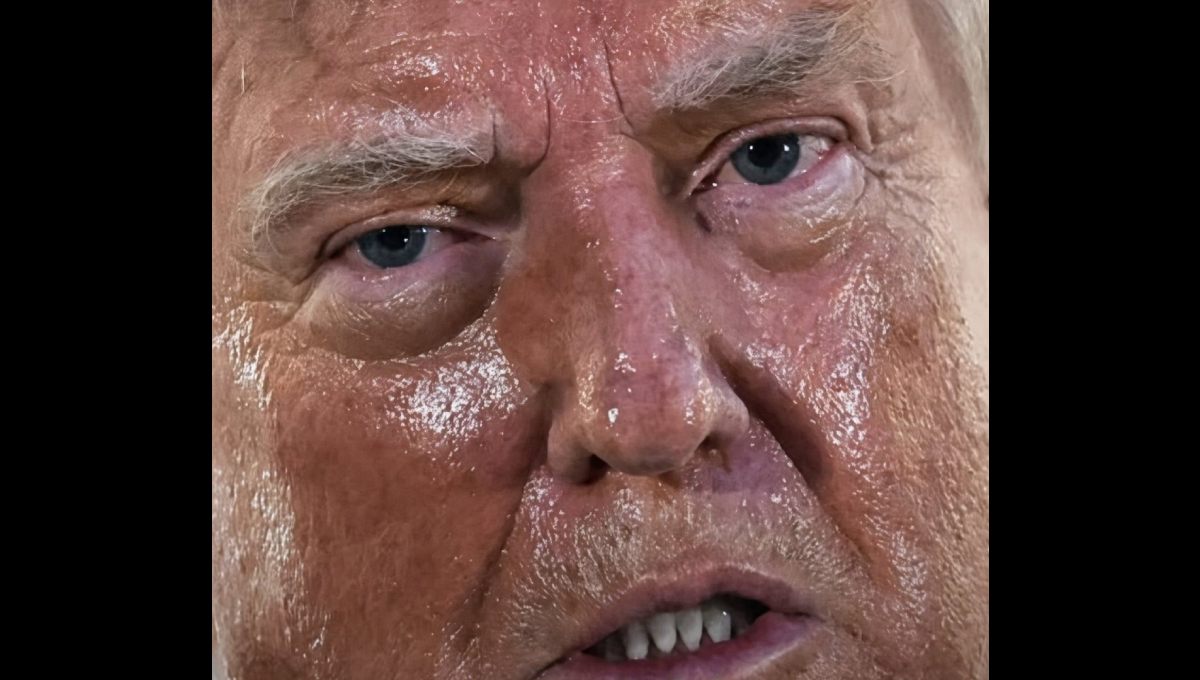
The Western war against Iran has entered a new phase of rhetoric, with President Donald Trump openly weighing whether to “annihilate” the Iranian state or “blow the entire nation up,” even as Tehran deploys forces along its southern coasts and presents seven conditions for talks.
The conflict, now in its seventh month, began on February 28, 2026, when the United States and Israel launched coordinated strikes under Operations Epic Fury and Roaring Lion. Those opening salvos killed Supreme Leader Ali Khamenei and senior commanders, triggering Iranian missile and drone retaliation across the region and a sustained campaign over the Strait of Hormuz.
An April ceasefire and a June memorandum of understanding both collapsed. By September, the fighting has settled into limited exchanges, a U.S. naval blockade of Iranian ports, tanker sinkings, and economic strangulation, with oil prices hovering near $104 a barrel.
NewsVoice has tracked the war from a perspective that emphasizes Western historical aggression: the 1953 CIA-backed overthrow of Mohammad Mosaddegh, U.S. support for Iraq’s 1980s invasion that killed hundreds of thousands of Iranians, and the current campaign as another attempt to dictate terms to a sovereign state that refuses to surrender control of its energy routes.
Recent posts from the account highlight Iranian missile strikes on U.S. bases in Jordan, celebrations in Arab streets, IRGC claims of damaging U.S. warships, and Trump’s habit of treating the Strait of Hormuz as if it were “Strait of Trump.”
On September 17, Trump told Axios he faced “a big decision”: whether to go in and annihilate the Iranian regime. Three days later, speaking to Fox News, he sharpened the language:
“My question is, if and when do I blow the entire nation up? They better behave.”
He listed three options—wipe Iran out, let it rot economically, or make a deal—and said “very big things” were coming. He also indicated he was open to meeting Iranian President Masoud Pezeshkian at the UN General Assembly.
Iran answered with both diplomacy and deterrence. Mohsen Rezaei, secretary of the Supreme National Security Council, said seven conditions had been conveyed to Washington via Qatar.
Publicly disclosed elements include an end to fighting on all fronts (explicitly including Lebanon and Yemen), lifting the U.S. naval blockade of Iranian ports, unfreezing Iranian assets, a halt to attacks and assassinations on Iranian territory, and an end to U.S. interference and support for “opponents of the revolution.”
Rezaei warned that rejection would mean a “decisive war” and that Iran had recently tested a multi-warhead anti-ship missile. Parliament Speaker Mohammad Bagher Ghalibaf added that the Strait of Hormuz would stay closed until those terms were met.
Iran’s army announced that most of its 420,000-strong force is now deployed along the borders, with significant concentrations in coastal provinces facing the Persian Gulf, Strait of Hormuz, and Gulf of Oman. Iranian officials said they had intelligence that the United States, with regional backing, was preparing new action.
The U.S. side continues to report munitions shortfalls after consuming large portions of Patriot and THAAD inventories earlier in the war. Official U.S. military deaths stand at 18, with hundreds wounded; Iranian casualties run into the thousands according to various tallies. Satellite imagery shows Iran rapidly rebuilding the Taleghan 2 facility at Parchin.
The dangerous path of constant provocation
From an Eastern vantage, the pattern is familiar: the Western alliance initiates a massive first strike that decapitates leadership, then treats the inevitable retaliation as proof of Iranian “aggression.”
The June memorandum collapsed after Iranian forces struck commercial vessels in the strait—an assertion of sovereignty over a waterway that carries a fifth of the world’s oil.
Washington responded by sinking Iranian tankers and tightening the blockade. Each cycle raises the cost for Gulf states that host U.S. bases and for global energy markets, yet the political incentive in Washington and Tel Aviv remains to keep applying pressure rather than accept Iran’s core red lines.
Trump’s latest threats illustrate the risk. Language of annihilating an entire nation or letting it “rot” economically is not bargaining; it is an attempt to force capitulation after a war that has already failed to produce regime collapse.
It ignores the historical memory that NewsVoice and similar outlets repeatedly surface: Iranians remember 1953 and the eight-year war with Iraq.
They also remember that previous U.S. “limited” campaigns have a habit of expanding. Pushing Tehran toward a “decisive war” while U.S. inventories are strained and midterm politics loom creates a classic overstretch problem. Regional states that the United States claims to protect have already absorbed Iranian missiles and seen their own energy infrastructure threatened.
The alliance’s approach also treats the nuclear file and the strait as interchangeable levers. Iran has used the pause to rebuild facilities and test new anti-ship systems. Constant talk of total destruction without a realistic off-ramp encourages hardliners who argue that only demonstrated strength prevents the next “Epic Fury.”
Meanwhile, proxies in Yemen and Lebanon remain active, and any new U.S. wave would likely be answered not only at sea but against bases in Jordan, Kuwait, and the UAE.
Trump is indeed threatening Iran again—this time in the most explicit terms of his presidency. The question the last 72 hours pose is whether the Western alliance will treat those words as theater ahead of UN meetings or as the prelude to another round of strikes that neither side can easily control. Iran has placed its conditions on the table and moved troops to the coast. The next move, Rezaei said, belongs to Washington.
This article used X accounts and AI to gather a summary of the current situation
Sources
- The Jewish Institute for National Security of America: Iran War Update: Sep 17–18, 2026
- New York Times: Iran War Updates: U.S. and Iran Sink Into Violent Cycle After Latest Strikes
- Axios: Trump tells Axios he’s approaching major crossroads in Iran war
- NewsVoice: The Iran War from the Iranian Perspective – Former Navy SEAL Tells All
- Deccan Chronicle: Iran Sets Seven Conditions for Talks with US to End War
- Congress.gov: U.S. Conflict with Iran
- USA Today: Trump ’deciding’ whether to ’blow the entire nation up’ in Iran threat