
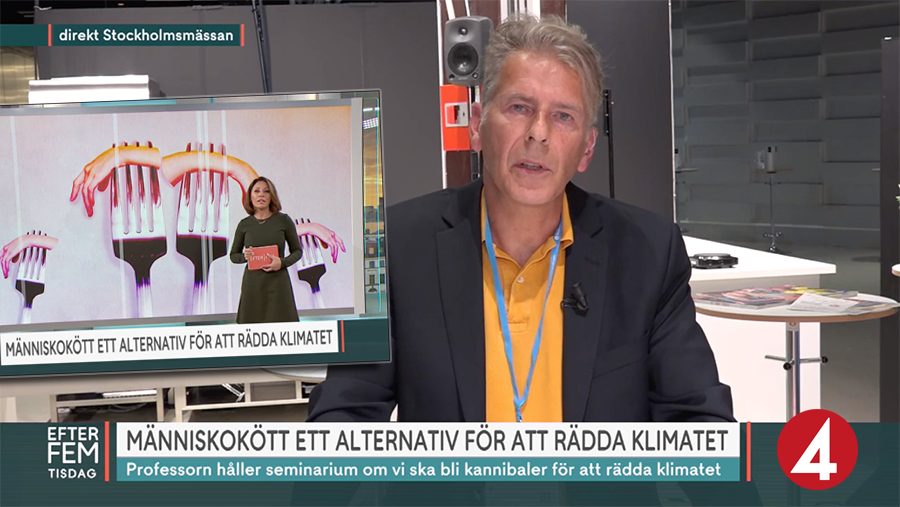
Behavioral scientist Magnus Soderlund believes we must consider the possibility of accepting cannibalism to save the climate, so-called ‘climate cannibalism’. One problem is that the person to be eaten must be dead. “I suppose that’s just the norm when you’re eating people…”, said Soderlund.
The “Gastro Summit – On the Food of the Future” trade fair took place at Stockholm Fair in September 2019. There, behavioral scientist Magnus Soderlund held seminars on the possibility of eating human flesh – to save the climate, TV4 After Five reported.
Tilde de Paula, a TV4 presenter, didn’t seem entirely on the same page concerning. She asked what obstacles stand in the way of accepting climate cannibalism.
Soderlund replied:
“The first thing, of course, is that the person who is to be eaten must be dead. That’s sort of the norm when you’re eating people, and killing people is, by and large, a taboo in itself, even if it’s bent a little in the sense that people murder one another quite wildly…”
“It’s probably the case that human flesh will never become a major, large-scale phenomenon for people in the Western world in our time…”
Soderlund concluded:
“If we now have to leave no stone unturned – at least eventually, when it comes to various climate and sustainability issues – then it is still important, in some way, to raise this issue.”
Source
- The video is no longer available on the original TV4 URL, but the page is still on WebArchive
Debate: NewsVoice comment on climate cannibalism
Today, Swedish citizens must actively opt out of organ donation themselves. If you do not refuse to donate your organs, you are automatically a donor. If the same authority – namely the National Board of Health and Welfare’s donation register – is to be held responsible for practiced climate cannibalism in Sweden, we must assume that the donation of one’s own body as food must be preceded by a question as to whether the person in question consents to being eaten after their death.
Is there a risk that life-support equipment in hospitals might be switched off prematurely – for example, for patients in a coma – if there is a desperate demand for human flesh?
Is it reasonable that relatives should be given priority to consume their own family member who has died of natural causes?
What about children? Is there a minimum donor age?
What price will human flesh command? What will the price per kilo be? Will the price differ depending on whether the flesh comes from a younger person or, for example, an elderly and sick person? Will the flesh of athletes or celebrities command a higher price?
If a Swedish Prime Minister dies, will the meat be sold to the highest bidder on the open market?