
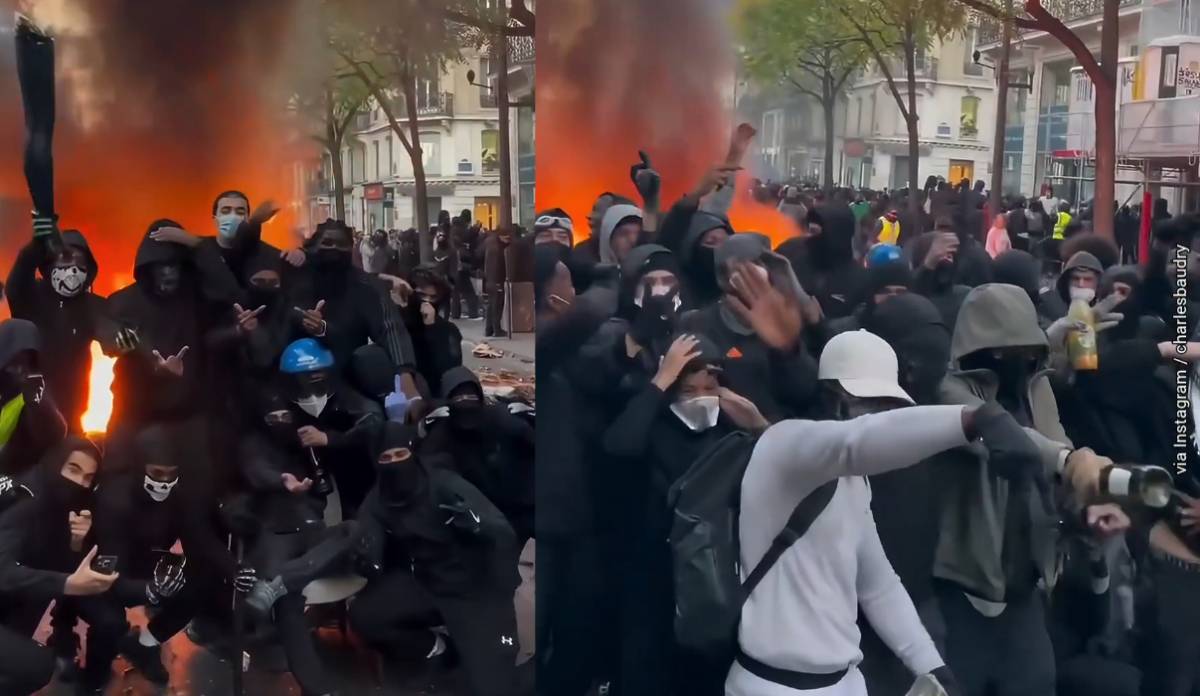
Western liberals imported the Third World into France and other countries in the name of diversity and compassion. They ignored fundamental questions of assimilation and compatibility. They were told it would lead to this, and they didn’t listen.
France is being torn apart by criminals who have discovered that a demonstration provides the perfect opportunity to loot businesses, burn public buildings, and terrorize entire communities.
The media continues to refer to these events as “student protests,” but what the hell does setting fire to a town hall have to do with education?
The historic 19th-century city hall in Limoges was gutted by flames, its roof collapsed, and rioters attacked municipal buildings in Marseille. Shops were ransacked in Paris, vehicles were burned, police were assaulted, and business owners were left surveying the destruction of everything they had worked to build.
Much of this is captured on video. These are criminal acts committed under the cover of demonstrations, and calling the perpetrators students does nothing to excuse the destruction.
Nearly 2,400 people were arrested following the October 17 unrest, and authorities reported damage affecting at least 3,000 businesses. More than 1,500 shops were reportedly ransacked.
There were peaceful demonstrators protesting legitimate grievances over the cost of living and deteriorating schools, but violent groups exploited those gatherings to steal, vandalize, and attack public institutions.
French police themselves described people arriving later in the day for the purpose of looting. Small business owners who had nothing to do with government policy are now left with shattered storefronts, stolen merchandise, insurance claims, and lost income. These are the people who employ their neighbors and pay the taxes that support the very public services France claims it cannot afford.
France has fallen. https://t.co/SaFGWqOclQ
— Breaking911 (@Breaking911) October 18, 2026
Macron’s government has spent years lecturing everyone about democracy while presiding over mounting debt, declining economic confidence, and a population increasingly furious over the cost of living. Now schools have been damaged, teachers and principals assaulted, and children deprived of their education.
The politicians cannot even guarantee that a school will remain open or a shopkeeper can operate without having his property destroyed. France already faces enormous fiscal problems, yet the taxpayer will ultimately be forced to finance the repairs while the businesses that were looted may never recover.
How much more destruction can an economy absorb when productive people are already struggling to survive?
Our Civil Unrest Model identified 2026 as a major target for widespread unrest in Europe years in advance. A reader in France wrote that his brother’s store had been completely looted and destroyed.
This is the human cost of these events that disappears when journalists reduce everything to a discussion about demonstrations. The model also indicates that the unrest could continue into November, although there may be a temporary reprieve.
The economic pressures have not disappeared, particularly the rising cost of energy, which is feeding inflation and further undermining living standards.
What concerns me even more is that our Civil Unrest and International War models are aligning during the same period. I recently explained that this is the first time I have seen both models converge in this manner. We have a Panic Cycle in Civil Unrest in 2029, while the War Cycle continues escalating toward 2027.
The Economic Confidence Model also points toward the broader political and economic instability unfolding into 2028 and the major turning point in 2032. These are model projections, not guarantees that every country will experience the same events, but the convergence is particularly troubling as Europe confronts rising energy costs, sovereign debt problems, and growing separatist pressures.
A left-wing French woman joined the student protests but was horrified when the second and third-generation migrants she was with started looting stores. She screamed “This isn’t the cause”
They pushed her aside, told her to shut up and said they had “urgent shopping” to do https://t.co/GEWhMCUBSF
— Visegrád 24 (@visegrad24) October 17, 2026
We are seeing unrest beyond France, including tensions in Belgium, Italy, Germany, and Albania. The common thread is deteriorating confidence in governments that continue demanding more money while ordinary people experience declining living standards.
I have explained that the combination of war, rising energy costs, fiscal deterioration, and political polarization is placing enormous pressure upon European society.
France is already struggling with debt and economic stagnation, and destroying businesses only accelerates the flight of productive capital. Investors do not need to wait for an official declaration of economic collapse when they can watch buildings burning and businesses being looted.
Our models point to further instability ahead, and the political establishment continues behaving as though another speech from Macron will somehow restore confidence.
France sacrificed the safety of its nation to appease the globalist Build Back Better open border agenda. Now the politicians are shocked that the invaders have not only failed to assimilate but are eager to topple the current regime.