
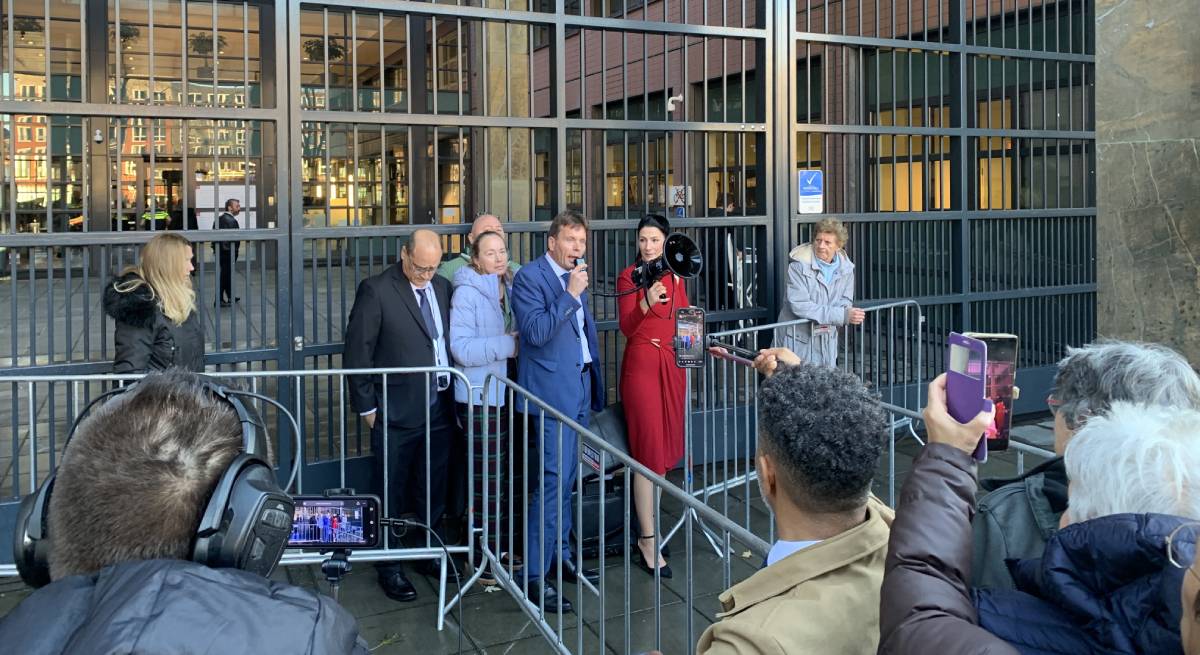
Michael Reichel was on site for NewsVoice as the sole Swedish media outlet to cover a damages case at the Rechtbank Noord-Nederland in the Netherlands concerning the Covid scandal, brought against, among others, Bill Gates, Albert Bourla (Pfizer), former Prime Minister Mark Rutte, and the Dutch state. Reichel summarises his impressions.
By Michael Reichel (Facebook profile)
Journalists from the EU and countries such as the US and Canada had gathered to attend the trial on 22 October. There were 17 defendants. The best known were Gates, Pfizer’s Bourla and Mark Rutte, former Prime Minister of the Netherlands.
The list also included state media, the WEF and other NGOs, semi-governmental bodies and the Dutch state. Far from everyone who bears responsibility, but the representation was sufficiently broad.
The presiding judge opened with a lengthy address on rules of conduct in the courtroom. He made it clear that no verdict could be reached as the case was too complex. The court sought to express empathy by acknowledging that the claimant had suffered tragic injuries. Furthermore, it was made clear that the court could not address anything not included in the charges.
The discussion began with the claimant’s representative, lawyer Peter Stassen, on how certain terms should be interpreted, for example, what ‘vaccine’ refers to in this context. The language used in court was surprisingly informal, quite unlike the bureaucratic language of Swedish court proceedings.
Following this, Peter Stassen began his opening statement (appendix). He started by stating that the Covid-19 pandemic was not a disease but a project. This set the tone for the rest of his statement, in which Stassen essentially described what we all already know regarding its connection to Klaus Schwab’s book The Great Reset and that the injections constituted a biological weapon.
Stassen went on to explain why the defense’s claims that this is all merely a conspiracy theory do not hold water. He therefore quoted Klaus Schwab (World Economic Forum) and his public statement that Covid-19 is a new “social contract” in which “social development will not lag behind economic development”.
How this is to be interpreted is clearly not that it is merely a book, but that it is a description of a ‘reset’ of everything we know, which will subsequently fill human consciousness with concepts such as biodiversity, digital identity, digital money, the energy transition and social credits, and so on.
Stassen also linked this to Agenda 2030 and showed just how far back in time all this had been planned. Stassen took it a step further and traced it back to more or less hidden organizations, right up to the banking families who today control access to and the use of the world’s capital.
Stassen left little to the imagination regarding what globalism is up to, the risks it entails, or which actors are involved today. He went on to say that Schwab’s book ‘Covid-19: The Great Reset’ is nothing other than Nazism’s ‘Mein Kampf’, version 2.0.
Stassen also highlighted statements made by the WHO’s Tedros A. Ghebreyesus as direct evidence of how the collaboration between the WEF and the UN operates. Stassen argues that it is not difficult to recognize Goebbels’ methods in the propaganda and Mengele’s in its implementation.
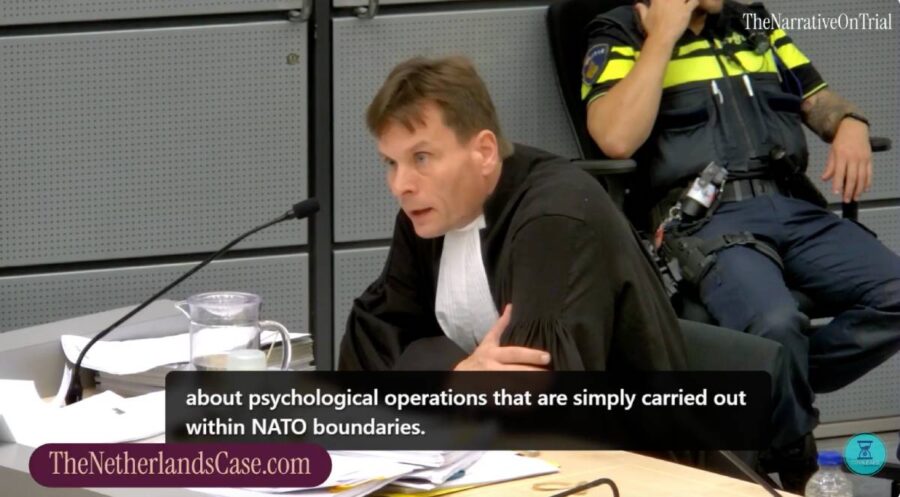
The defence consisted solely of lawyers acting on behalf of the defendants; in other words, none of those actually charged were present.
Read more in NewsVoice: The trial against Bill Gates, Albert Bourla and Mark Rutte
One thing that was clear from the outset was just how weak – indeed, almost non-existent – the defence’s arguments were. No one addressed the documented evidence, despite the fact that the indictment comprises 14,000 pages of material. All the lawyers who spoke repeatedly chanted the mantra: “safe and effective”.
This must be seen as something laughable and, not least, as self-defeating behaviour, as these very words are such clear evidence of how precisely this manipulation of public opinion has taken place. At the same time, given the now vast and openly available clinical and statistical evidence of the deaths and harmful effects caused by the injections, it is no longer possible to dispute these facts. To persist with “safe and effective” in this situation also means persisting in accepting blame.
The defendant’s representative claimed that the injections had saved around 20 million lives, but Bourla’s representative was visibly flustered by the situation, as evidenced by the flush on his face.
Bill Gates’s counsel was the one who most strongly displayed emotional detachment when he argued that there was no demonstrable causality between Gates’s advocacy of the injections and the claimant’s injuries.
The State’s counsel, lawyer R-W Medhuis, argued that Peter Stassen is attempting to create a “preferred reality”, that is, a “preferred reality” that is not real. The attempt to discredit both witnesses and the evidence is, of course, a classic tactic in court to sow doubt. In this case, the attempt was without substance. Those of us who had expected an interesting intellectual duel ‘one against seventeen’ were deeply disappointed.
Although several representatives chose not to respond and largely relied on what had already been said, one can observe a certain difference between the statements made by the Dutch state and those made by the representatives of Pfizer (Bourla), Gates, NGOs, the WEF and the mass media.
It will be interesting to see how this rift might widen. We know, of course, that states have, through agreements, exempted the pharmaceutical industry from liability claims. Consequently, no civil agreements are valid, as this contravenes the law.
Stassen’s closing statement was nothing less than a politely worded, yet firm, appeal to the court regarding the responsibilities and obligations they bear in the ongoing proceedings, which includes the requirement to establish the truth. It was quite clear that Stassen commanded the room, and he occupied the highest position both legally and morally.
Immediately after the court adjourned, the visitors met those waiting outside on a chilly afternoon with a light drizzle. Despite this, there was some mingling, and I had the opportunity to listen to a discussion about how several of the defence counsel had moral qualms about their assignments.
Apparently, having familiarised themselves with the witness statements and evidence, they were moved by what they had realised. They understood what was at stake and that they had chosen the wrong side in the writing of history.
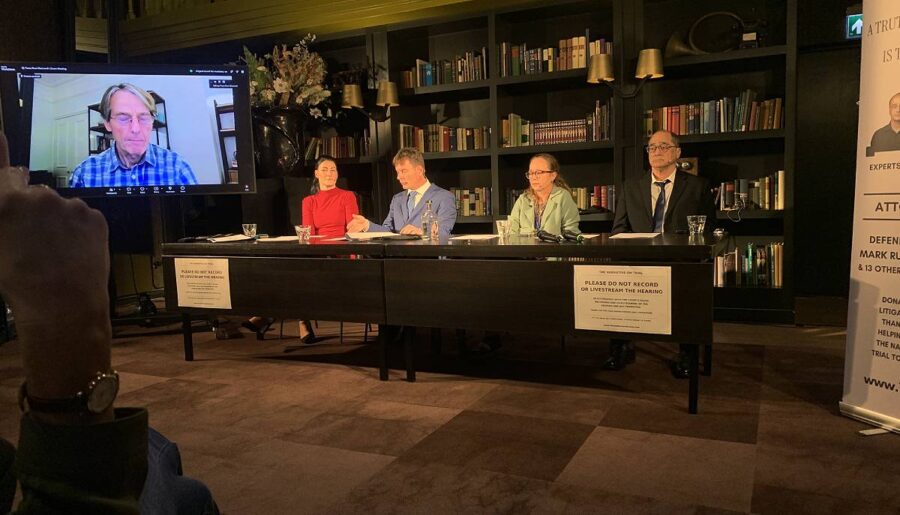
During a conversation with Stassen at the subsequent press conference, he also mentioned that if he’d been acting on behalf of the defendant, he would have chosen not to respond at all. We also saw clear evidence that, whatever the defence said, they were simply sinking deeper into the quicksand of lies.
What is it that we have actually witnessed?
It took me nearly a full day to fully realise that what has happened is something truly momentous and significant. There is a historical dimension to it. It is so momentous that the verdict itself is secondary to the reality of the situation.
What has happened is that we now know the names of a number of individuals who were previously invisible. We now know which individuals were pulling the strings, right up to the very top of the hierarchy. They have been exposed and made accountable to the people and to justice.
This is a turning point in the fight against an evil that so many have been waiting for. Think about that.
What about the verdict? Well, no one can even imagine convictions being handed down, but as I said, that is not the point here – it is the process itself, and in that process the objective has already been achieved.
The demands of the claimants – the two who have died and a further two who are in a dire state – are not about financial compensation but about the truth being established in law. The victims are not going through this legal ordeal solely for their own sake, but for the sake of all Dutch people and, by extension, the world.
Nor is it a coincidence that the trial took place in the Netherlands. On the one hand, there remains an unresolved responsibility – one that has never really been addressed – regarding how the Dutch people were betrayed by their own royal family during the Second World War; and, on the other hand, just as in Germany, Nazism has not been fully eradicated from institutions and organizations, which is the reason for the stigma that still lurks beneath the surface.
Furthermore, despite this, there is still a legal system that allows appeals to proceed all the way to the highest court without hindrance.
By Michael Reichel (Facebook profile)