
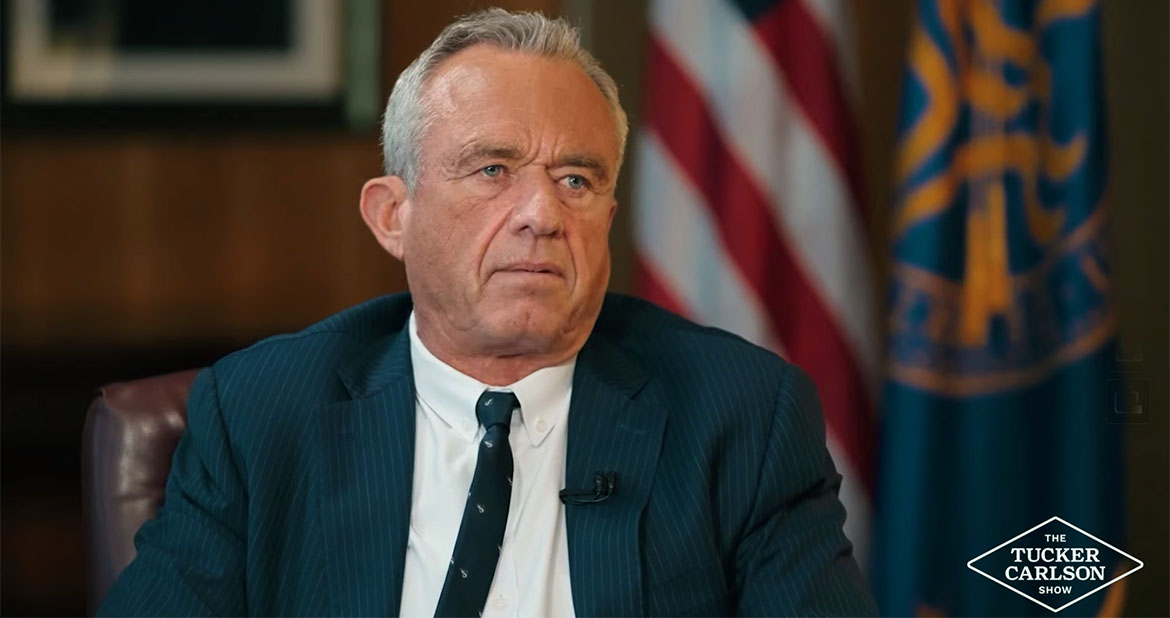
Robert F. Kennedy Jr. sharply criticized U.S. involvement in the Russia-Ukraine war during a speech, calling it an unnecessary conflict driven by military contractors and alleging that billions in American taxpayer dollars ultimately enrich powerful financial interests rather than aid Ukraine.
Kennedy argued that the war could have been avoided through diplomacy and portrayed ongoing U.S. funding as a boon for defense manufacturers and asset managers like BlackRock, while imposing burdensome conditions on Ukraine. He highlighted the scale of American spending and questioned its long-term value to taxpayers.
”This is a war that should have never happened,” Kennedy said. ”It’s a war the Russians tried repeatedly to settle on terms that were very, very beneficial to Ukraine and us. The major thing they wanted was for us to keep NATO out of Ukraine.”
He pointed to NATO expansion as a key driver, noting that new member countries must align their militaries with NATO standards, creating captive markets for major U.S. arms makers.
”The big military contractors want to add new countries to NATO all the time,” Kennedy explained. ”Why? Because then that country has to conform its military purchases to NATO weapons specifications, which means certain companies — Northrop Grumman, Raytheon, General Dynamics, Boeing, and Lockheed — get a trapped market.”
By March 2022, the U.S. had committed $113 billion to Ukraine, according to Kennedy, with an additional $24 billion pledged shortly before his speech and President Biden requesting another $60 billion. He contrasted the spending with domestic needs:
”We could have built a home for almost every homeless person in this country.”
Kennedy warned that even larger costs would arise post-war for rebuilding infrastructure damaged in the conflict.
He referenced Senate Minority Leader Mitch McConnell’s comments (web) on the aid, using them to underscore his point about where the money flows.
When asked if the U.S. could afford to spend $113 billion on Ukraine, McConnell responded, according to Kennedy: ”Don’t worry. It’s not really going to Ukraine.” McConnell added:
”It is going to American defense manufacturers.”
Kennedy goes on:
”So he just admitted it’s a money laundering scheme, and who do you think owns every one of those companies? BlackRock.”
Kennedy also addressed Republican Sen. Tim Scott’s description of the aid as a loan rather than a gift.
”Raise your hand if you think that that loan’s ever getting paid back,” he said. ”Yeah, of course it’s not. So why do they call it a loan? ’Cause if they call it a loan, they can impose loan conditions.”
Those conditions, he claimed, include extreme austerity measures that would perpetuate poverty in Ukraine and require the sale of government-owned assets, particularly its vast agricultural land, described as the richest farmland in the world and Europe’s breadbasket, to multinational corporations.
”Ukraine has to put all of its government-owned assets up for sale to multinational corporations, including all of its agricultural land,” Kennedy said. ”They’ve already sold 30% of it. The buyers were DuPont, Cargill, and Monsanto. Who do you think owns all of those companies? BlackRock.”
He further alleged that BlackRock secured the contract to rebuild Ukraine, awarded by the Biden administration in December.
”They’re doing this right in front of us. They don’t even care that we know anymore ’cause they know that they can get away with it.”
Kennedy concluded by accusing powerful interests of sowing division to maintain control:
”They keep us at war with each other. They keep us hating on each other. They keep the Republicans and Democrats fighting each other, and Black against white, and all these divisions that they sow.”
The speech reflects Kennedy’s long-standing skepticism of U.S. foreign policy and military interventions, positioning his campaign as a challenge to establishment approaches on both sides of the aisle.
Sources
- Kennedy speech, April 19, 2023, in Boston, Massachusetts
- Republicanleader.senate.gov: McConnell Highlights Investments in American Defense