
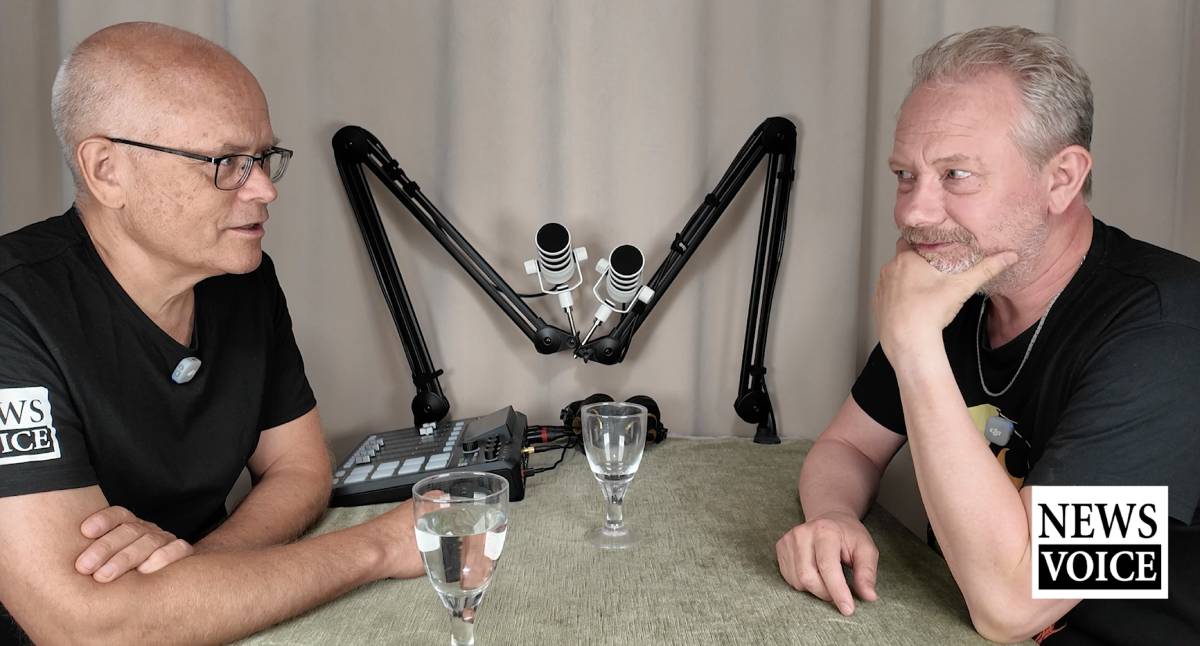
Torbjorn Sassersson of NewsVoice interviewed Hakan Julander about his impressions from his most recent trip to China in the summer of 2026. Julander discusses the country’s tremendous development, the West’s negative perceptions, and what he considers to be facts and myths about China.
Julander describes a country that has become wealthier, cleaner and more developed than on his previous visits, whilst at the same time dismissing several common Western perceptions.
The trip was organised by the Chinese organisation Chinese Association for International Understanding, which has been inviting journalists, think tanks and politicians from the West since the 1980s.
The group of 13 people was a mixed one: journalists from Greece, a representative from an Austrian military think tank, writers from the Danish newspaper *Arbejderen*, a former Danish MP and a conservative Spanish MP.
Julander, who had previously visited China three times as a tourist, describes the trip as both a cultural and a propaganda trip, but sees nothing negative in the latter. The itinerary was packed: Dunhuang in Gansu Province, Wuhan and Shanghai.
From desert to megacities
In Dunhuang on the Silk Road, in the middle of the Gobi Desert, the group visited Buddhist caves and saw a 30-metre-high Buddha carved into the mountain. A major conference on Sinology was also held there. Julander notes that no Nordic China experts took part. In Sweden and Scandinavia, China experts are, by definition, sceptical of China these days, he argues.
The group also saw an experimental solar power plant where mirrors concentrate sunlight onto a tower containing molten salt to generate electricity. The plant is not yet profitable, but Julander highlights China’s willingness to test new technology on a large scale.
In Wuhan, which he describes as a modern metropolis and not just a laboratory or a wet market, the group visited an ecological park by a lake that had previously been heavily polluted. The guide was reluctant to discuss the origins of Covid and laughed at the idea that the virus came from a fish market with bats. According to Julander, many Chinese people believe it came from a laboratory.
At a car factory, the Voyah brand was being manufactured. Several models were self-driving. Julander estimates that around half of the car fleet in Wuhan consists of electric cars.
The group also visited a factory producing humanoid robots, which help children with their homework. Here, care robots and specialised robots for the police and fire service were demonstrated. When Julander questioned whether it was a good thing for children to interact with a robot rather than their parents, the guide pointed out that this would allow parents to work more.
Collective responsibility and everyday life
Julander contrasts Chinese collectivism with European individualism. He likens the Communist Party, to which around 6–7 per cent of the population belong, to a housing association: it takes time and is a bit tedious, but you take responsibility.
In Shanghai, they visited so-called ‘citizen hubs’, local centres where residents can sort out paperwork, receive healthcare, eat cheaply and simply sit down. One official had an analogue whiteboard with magnets marking shops in the area, including those employing Party members.
Julander dismisses the idea of a national social credit system as a Western myth. According to a Swede who had lived in Shanghai, there was a local trial in a small town outside Beijing which was subsequently scrapped. When he raises the matter with the Chinese, they laugh; it’s like someone believing there are polar bears in Stockholm.
The WeChat app is used for chatting, managing money and making payments. Julander had to switch to Alipay because there are problems topping up funds or linking cards to WeChat from foreign providers whilst in China. You have to link your bank card before travelling to China (editor’s note).
He describes a society with low crime rates, unarmed police, no visible drug problems and no homeless people on the streets. They are looked after and given help. At the same time, there is a lack of what he calls “freedom to fuck up”.
When asked whether China is a democracy, Julander answers no, but argues that in practice the system can function in a more people-centred way than the Western model. Five-year plans are established from the grassroots level upwards. Those who reach the top have worked their way up and have not gained entry via Swedish-style party careers, according to him.
Protests against corruption or environmental scandals do occur and are tolerated when people have the law on their side.
Julander says he would very much like to return to China to take the ferry along the Yangtze River from Wuhan to Chongqing, where his wife used to work.
Julander concludes with a few words about the Dissident Club, a network that grew tired of a one-sided media narrative, particularly after 2022. The group brings together people from different political backgrounds around the causes of peace and freedom of expression and organizes lectures. They were recently visited by the American whistleblower John Kiriakou. Among other things, a visit by the Norwegian researcher Glenn Diesen is planned for the autumn.
Related