
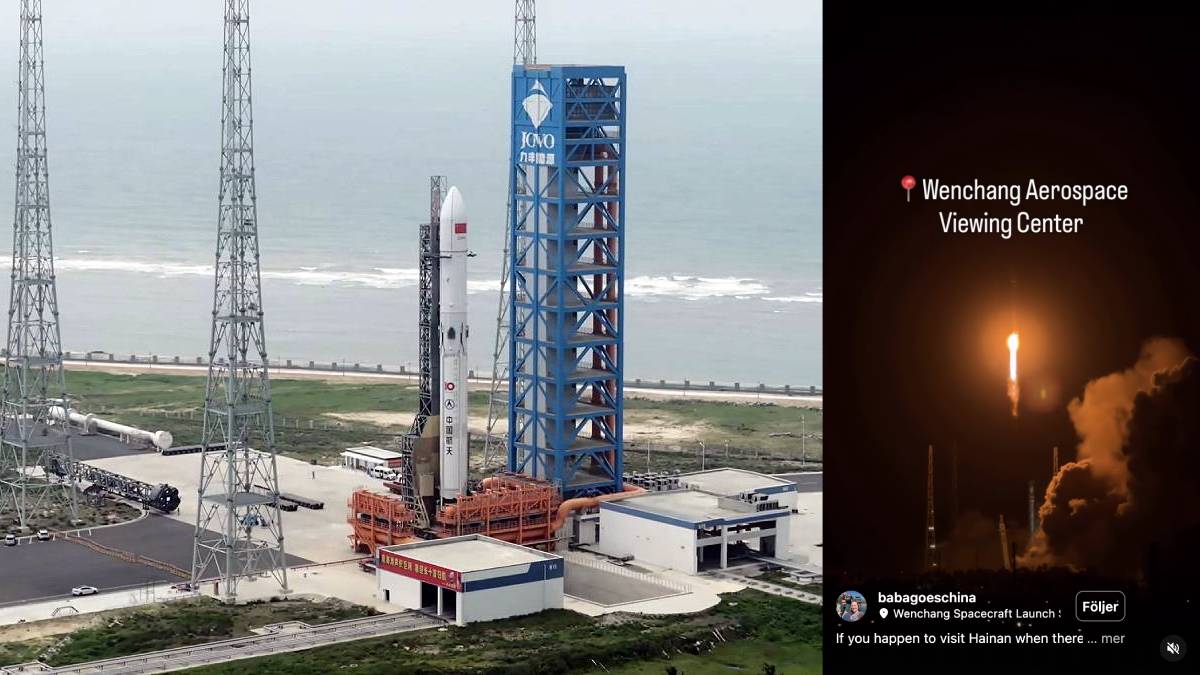
Two launch sites, 670 space companies and a town that went from 5 hotels to 150: Wenchang is a city that showcases Hainan’s plan beyond tourism.
By Magdalena Sawyer, Baba Goes China

Before I first visited Hainan, I thought about it mostly through the marketing catchphrase: the “Hawaii of China”. I expected a tropical paradise with a Chinese twist. I thought of sandy beaches, warm weather all year round, great food and a vibrant island atmosphere.
Even though I knew that rocket launches happen in Hainan, I didn’t expect to be waking my kids at midnight to watch a Long March 12 rocket carry a new batch of internet satellites into orbit. Yet that is what we did, on 10 October at 3:27 in the morning.
I also didn’t know how the kids would take it: would they be able to stay up? It turned out the viewing centre is more than just a place to watch a rocket launch. There are robot dogs, VR simulations, a children’s playground and games with prizes, plus, of course, all the excitement of the countdown before the launch.
Somewhere between the playground and the countdown, I began to see a different side of Hainan. We had come to watch a working space launch, and a whole visitor experience had been built around it. The same industry sending satellites into orbit was giving families like ours a new reason to visit.
That combination is what makes Wenchang interesting. Hainan wants to build an economy that reaches beyond tourism, and space is part of that plan. In Wenchang, the two are already growing together: launch sites attract aerospace businesses, while the launches themselves bring visitors, and with them demand for hotels, restaurants and things to do.
Hainan’s ambitions extend well beyond attracting more holidaymakers. The island is being developed as a Free Trade Port, with policies intended to attract investment, expand trade and encourage companies to manufacture there.
On 18 December 2025, it began island-wide special customs operations, making it easier for eligible goods to enter from overseas without import duties. Further incentives encourage businesses to process goods on the island before selling them to mainland China. The aim is to make Hainan a place where more products are made and more businesses operate.
Wenchang offers a tangible example of that broader ambition. Its space industry predates the new customs arrangements, but the businesses gathering around its launch sites show the kind of industrial development Hainan wants to encourage.
The opportunity extends beyond launching rockets: it includes building them, manufacturing satellites and developing services around both. For visitors like us, the launch is the spectacle. For Hainan, it is one part of a much bigger economic plan.
Wenchang now has two operational launch sites. The Wenchang Space Launch Site, which began operating in 2016, has sent the modules of China’s space station into orbit and launched the Chang’e-5 and Chang’e-6 Moon missions.
Nearby, the Hainan Commercial Spacecraft Launch Site carried out its first launch in November 2024. It serves a growing demand for commercial launches, including the satellite-internet networks that the rocket we watched was helping to build.
Around these launch sites, a wider industry is taking shape. Wenchang International Aerospace City hosts more than 670 space companies, alongside facilities for rocket assembly and a satellite factory designed to produce 1,000 satellites a year. That production capacity is an ambition rather than current output, but it gives a sense of the scale being planned: Wenchang wants to become a place where spacecraft are built as well as launched.
The changes are also reaching businesses with little direct connection to aerospace. Longlou, a coastal town within Wenchang, reportedly had just five hotels and guesthouses in 2016; it now has more than 150. For local accommodation owners, a launch schedule is becoming a tourism calendar.
Wenchang seems to be in the middle of a transformation, with different parts of the city moving at different speeds. Around the launch sites in Longlou, hotels and guesthouses have multiplied. New attractions such as the Jixing Meteorite Museum, inside the Wenchang Space Supercomputing Centre, are giving visitors more ways to explore its connection to space.
Yet the historic streets of downtown Wenchang still feel largely untouched by that tourism boom, without the rows of souvenir shops I have come to expect in popular destinations.
For me, that is part of the appeal. You can watch a rocket launch, visit a space-themed museum, then wander through neighbourhoods where everyday local life carries on. For travellers tired of places where every corner has something to sell them, that could be a reason to linger. This mix of ambitious new developments and an older city still comfortable in its own rhythm makes it interesting to visit now.
Watch lunch video on Instagram
Having seen how China pursues its ambitious targets, whether in electric vehicles, renewable energy or now AI and robotics, I expect not only Wenchang but the whole of Hainan to change in the coming years. It will be a fascinating transformation to follow closely.
Sources
- Island-wide customs operations from 18 Dec 2025, duty-free imports and processing incentives: People’s Daily via China Daily
- Wenchang Space Launch Site, operating since 2016, and its missions: Xinhua
- Commercial launch site, first launch in November 2024 and commercial demand: Science and Technology Daily · Xinhua
- Aerospace City’s 670+ space companies, rocket assembly and satellite factory: China News Service · CLS via Sina Finance
- Longlou hotels and guesthouses, 5 in 2016 to 150+: Xinhua
Magdalena Sawyer is a travel writer and the creator of Baba Goes China, a family travel website recommended in Lonely Planet’s China 2025 guidebook. She travels to China frequently and is fascinated by how quickly the country is changing.